Showing posts with label Philip Jackson. Show all posts

June 02, 2017

Five from York

The Minster
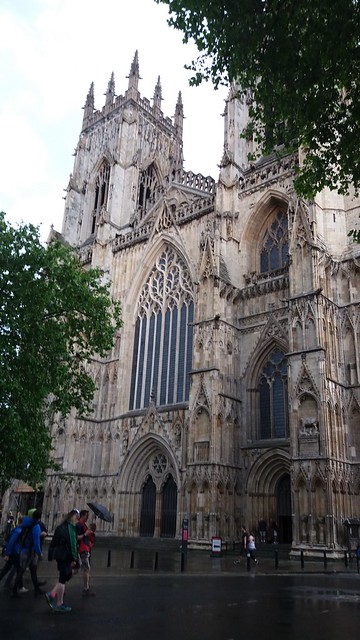
 Yorkshire's a funny county. They do things slightly differently there. For example, they eat fruit cake with cheese. (Try it before you sneer!) And where everyone else calls the biggest church in an area a cathedral, York (and other Yorkshire towns) has a Minster. Apparently, according to the Internet, a Minster church is one that was established in Anglo-Saxon times and was attached to a monastery. (But that doesn't explain why Peterborough Cathedral isn't a Minster.) Anyhow, one of the most beautiful sights in York is the Minster. It's a lovely church and really is the heart of Yorkshire - a name they have given to one of the Minster's glorious stained glass windows. Only an outside view, I'm afraid, but you can make out the heart pretty much central to the photo.
Bars and gates
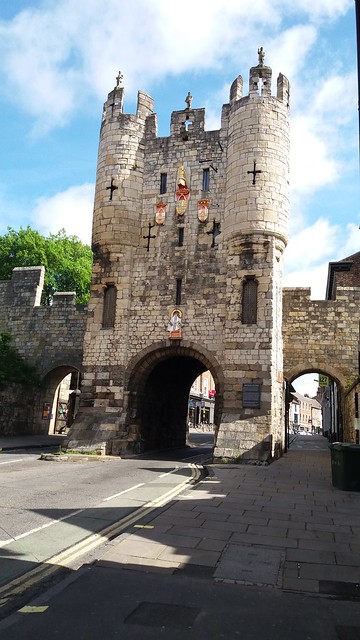
Talking of doing things differently - this is Micklegate Bar. It's one of the ways through the old city walls. (Incidentally, York has one of the most complete, original medieval city walls in the UK.) You might think it's called Micklegate because it's a gate, right? Well it isn't. Gate means street. Bar means gate. And mickle means small. So this is Little Street Gate. 
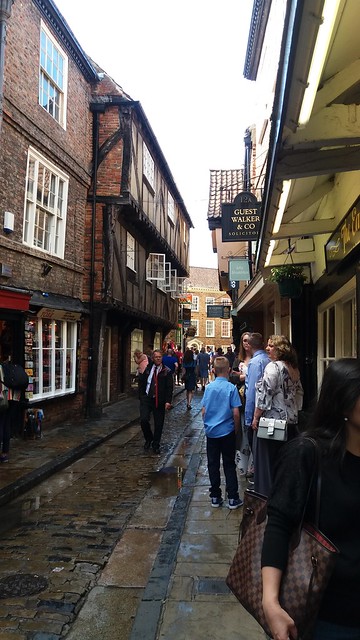

The Shambles
 The Shambles is one of York's best known streets. It has lots of claims to fame: Europe's most visited street; Europe's best preserved Medieval street; and most recently, the inspiration for Diagon Alley in the Harry Potter films. In fact you can hear lots of different languages as you walk along the narrow way: you don't understand a word until someone says "Diagon Alley", then continues talking in whatever native tongue they're using.

The word Shambles originates from the Medieval word shamel, which meant booth or bench. The street was the home of the butchers of York and the road has deep channels at each side where water could be sluiced through to wash away the blood and waste.

The street is so narrow, and the buildings overhang so far, that it's possible to shake hands across the road from the upper storeys.
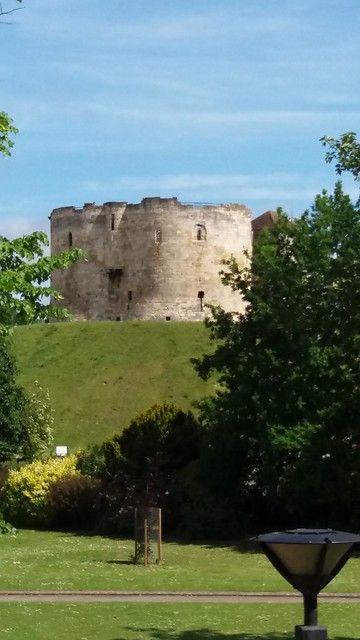

Clifford's Tower
Clifford’s Tower is one of York's best known landmarks. It is part of the old York Castle, once the centre of government for the north of England. It's a motte and bailey structure: the motte being the steep mound and the bailey being the flat area around the mound. Originally there was an 11th-century timber tower on top but it was burned down in 1190, when York’s Jewish community, some 150 strong, was besieged by a mob and forced to seek refuge inside. They committed mass suicide. The present limestone tower dates from the 13th century and was surrounded by a moat

The views from the top are stunning, although tourists don't care about walking in front of you while you're trying to capture it on video. And they seem to ignore the 'one way system' signs on the narrow, spiral staircases. Ho hum.
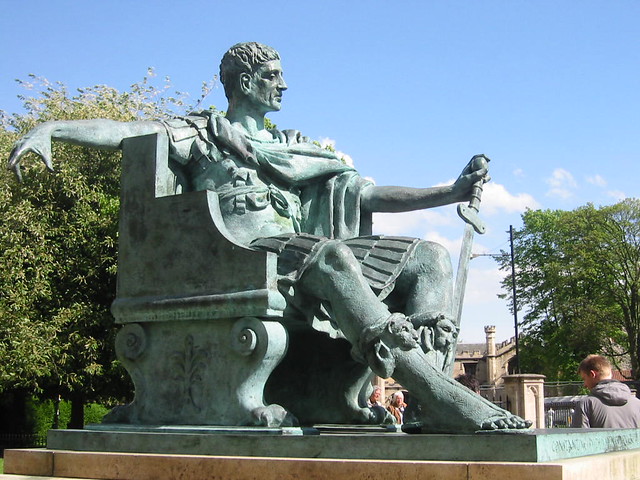
Romans
Lastly we're going back in time and forward at the same time. York was, of course, established by the Romans, who called it Eboracum. There are still remnants of the old Roman town. Stonegate, for example, has the original Roman street below it and anyone having to dig up the road soon finds Roman masonry. There's a Roman pillar stands opposite the Minster, marking the site of the basilica. It was found during repair excavations at the Minster in 1969 and erected nearby. Between the pillar and the Minster is one of my favourite public sculptures in the whole country. It's Constantine the Great by Philip Jackson; a life size bronze of the Emperor sitting in an elaborate chair and holding a broken sword. Constantine was declared emperor in York in the year 306.

OK so now you have to go and visit the wonderful Tricky over at FAST blog to see what other fives people have collected this week. 

February 03, 2017

History sculptures

One thing I love is public sculpture  that is, things that you find on the street, or the side of buildings, rather than having to go into a galery or museum to see.

Here, for Five on Friday, are a selection of statues or sculptures that commemorate something historical.


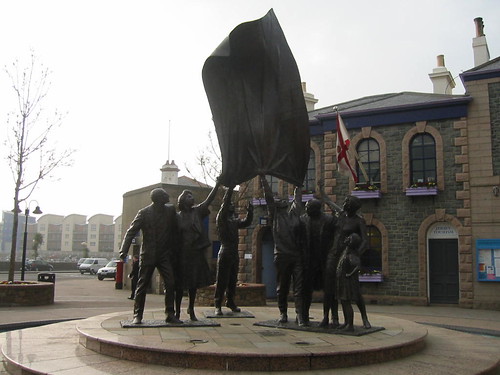
Jersey was the only part of the British Isles to be occupied by Germany during the second world war.  This is a sculpture commemorating the liberation. It stands in a square in St Helier where the advance parties of the Royal Navy and British Army landed to drive out the German forces.

The design met with severe criticism from some sources because it shows a group of figures releasing doves of peace. any pointed out that conditions under German rule had been so strict that people were close to starvation and any doves on teh island would have been eaten!

It's by Philip Jackson. One of my favourite sculptors.


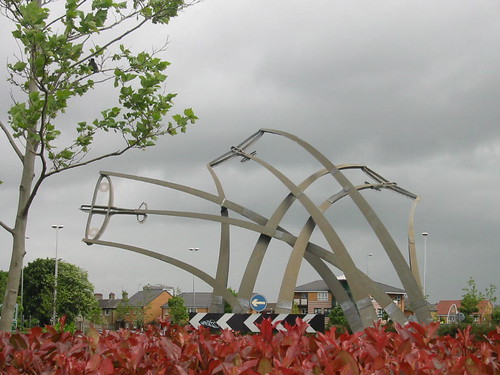
This one stands on a traffic roundabout in Birmingham, outside the Castle Bromwich Jaguar (engine) factory. It's called Sentinel, and it shows a number of Spitfire planes (which had Jaguar engines) taking off. It's by Tim Tolkien, great grand nephew of the Lord of the Rings author.


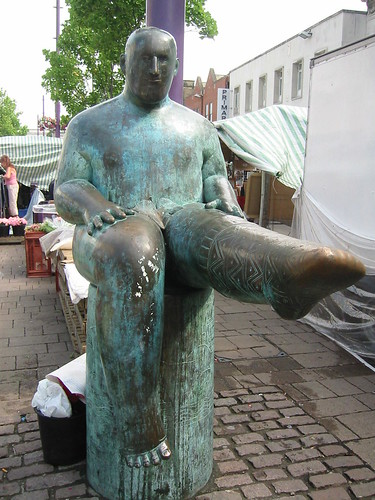
This bronze by Shona Kinloch sits in the market place in Loughborough (which just won an award for being one of the best outdoor markets in the country - and it is) and represents much more than the town's connection with the hosiery industry.

From the national public art record.....
"According to the sculptor, the 'sock pattern echoes the zig-zag of the new bollards in the Market Place, while the surrounding Art Deco buildings (e.g. the Curzon Cinema) inspired his deco hair cut'. On the figure's right arm is an incised tattoo of a heart above the word 'Loughborough' set within a scroll motif. The bollard on which he sits is decorated with incised images from the history of the town: a railway track and train, representing Thomas Cook's first tourist excursion from Leicester to Loughborough in 1842, a canal and barge representing the introduction of the Soar Navigation and Leicester Navigation in the eighteenth century, factories and sheep for the woollen industry, one of local agriculturalist Robert Bakewell's longhorn cattle, bells to represent the town's bell-founding industry, and the towers, etc. of Loughborough University. The sculptor has also commemorated the year in which she began the piece with an image of the Hale Bop comet."


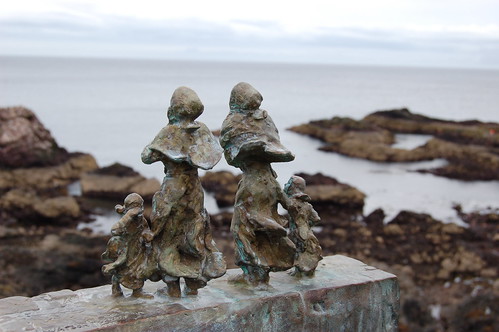
On the night of 14 October 1881 a terrible storm blew up off the east of Scotland that affected almost every fishing village along the coast.

The storm devastated the fishing fleet and 189 fishermen were drowned, many within sight of the shore. 129 were from Eyemouth, 24 from Burnmouth, 15 from Newhaven, 11 from Cove, 7 from Musselburgh, and 3 from Coldingham Shore (now called St Abbs) More than 70 women were widowed and 300 plus children left without fathers as a result.

This is one of a series of monuments that stand along the shore in the villages that lost their men. Erected to mark the 125th anniversary of the disaster. St Abbs Bronze sculpted by Jill Watson.


This photo fails to give any idea of the scale of this piece. It's huge: 35 feet high and 27 feet wide.

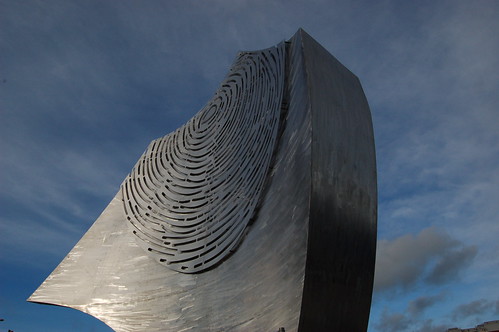
The sculpture in Tunstall, part of Stoke on Trent, stands at the centre of a new shopping precinct, which used to be the site of the old Wedgwood factory. It represents a shard of Roman pottery, carrying the potter's fingerprint, that was found in an underground kiln when the site was redeveloped. Truly this piece marks the centuries of pottery production in the area.

It's by sculptor Robert Erskine who very kindly contacted me after I posted this photo on Flickr wondering why it hadn't been made in ceramic. It wouldn't have worked, apparently, and certainly wouldn't have survived very long. The Tunstall Shard is stainless steel and should be good for a couple of centuries. It's also wonderful.


April 22, 2016

Five on Friday: hands

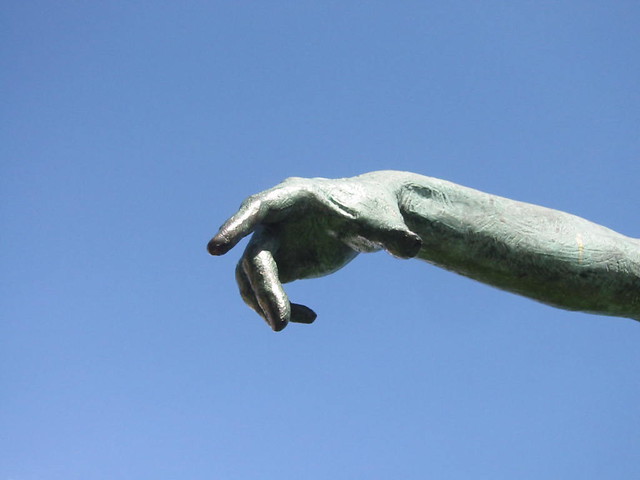
Welcome to Friday and my contribution to Five on Friday organised by Amy at Love Made My Home.  This week I'm indulging a little hobby of mine. I love to take photos of hands - in particular the hands on sculptures. These five are all from statues of historic or significant figures.

Captain Vancouver
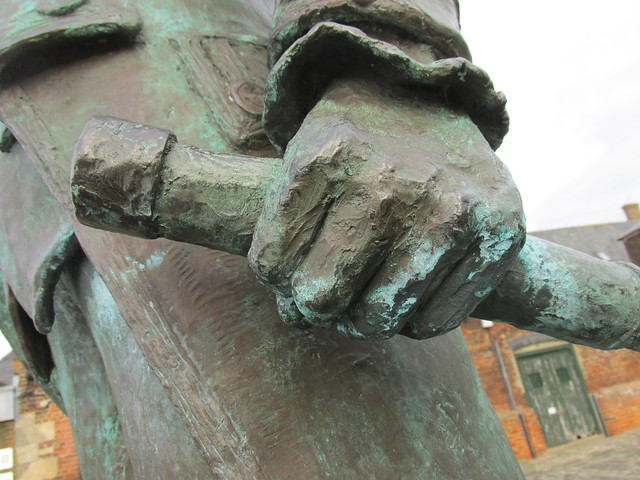
Captain George Vancouver was an English Naval officer, best known for his 1791–95 expedition to explore and chart North America's northwestern Pacific Coast. He was born in 1757 in Kings Lynn, Norfolk, and his statue stands proudly in front of the old Customs House in the town.  He's holding a spyglass in his hand to watch out for new horizons.

Sir John Betjeman
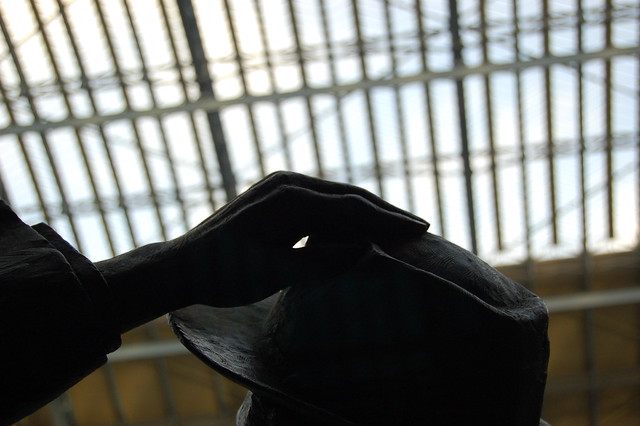
John Betjeman was a poet, and for many years was the UK's Poet Laureate. This statue of him stands on the upper deck at St Pancras Station in London.  Betjeman was one of the driving forces behind a campaign to save the station when developers wanted to pull it down in the 1960s.


Patrick Lichfield
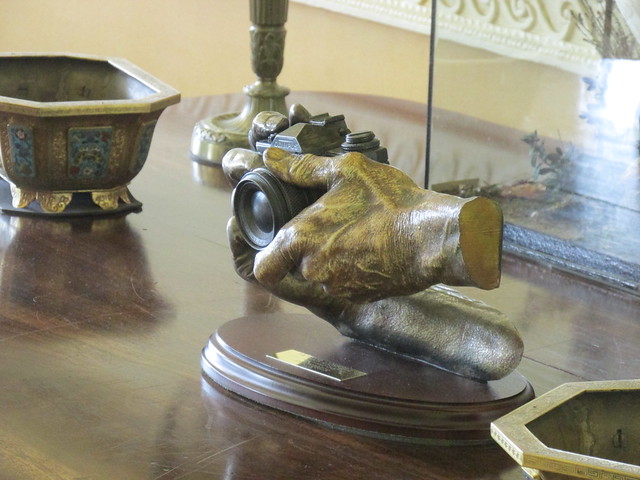
As you can see this sculpture is all about the hands.  It stands on a desk in the former private apartment of Shugborough in Staffordshire, the ancestral home of Patrick, Earl of Lichfield. He was a well known society photographer and cousin of the Queen. His house was handed over to the National Trust in lieu of death duties after fate killed off both his father and his grandfather within a very short time. He was allowed to stay there in a rather luxurious apartment, which is now part of the house tour.

Constantine the Great
A seated figure of Emperor Constantine the Great reclines outside York Minster. It commemorates the fact that he was the first christian Roman emperor. He was proclaimed emperor at York just a few yards from where the sculpture now stands (on a spot that's now under the Minster building.)
The sculpture is by Philip Jackson, whose work I admire greatly. I realise that this portion doesn't give you much to go on, but trust me, it really sums up the incredible imperial arrogance that the rest of the work illustrates.

James Brindley
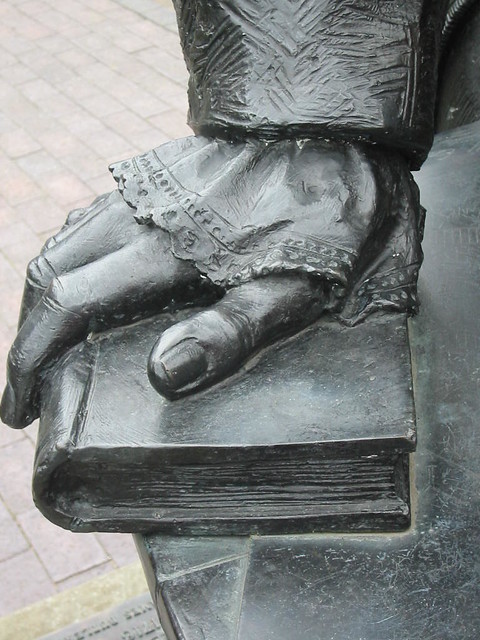
James Brindley was one of the foremost canal engineers of the eighteenth century. He was responsible for the first canal in Birmingham, which eventually led to the development of the complex network that criss-crosses the UK today. A statue of him stands at the terminal of the Coventry Canal, just off the modern-day ring road. It's a life-size bronze by Colin Melbourne and I love this little detail of the lacy cuff of his shirt.

So now there's just one last thing for you to do.  Go visit Amy by clicking on the pic below, and see what everyone else has to offer this week.