Showing posts with label Romans. Show all posts

June 02, 2017

Five from York

The Minster
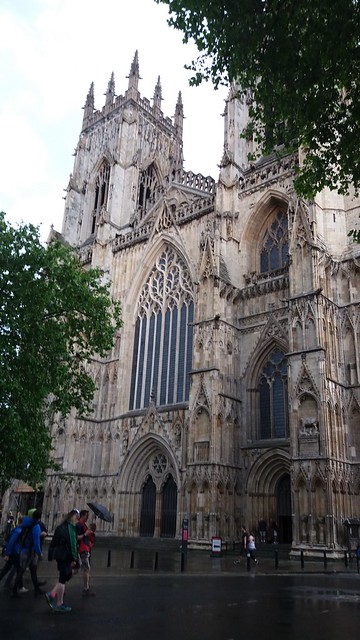
 Yorkshire's a funny county. They do things slightly differently there. For example, they eat fruit cake with cheese. (Try it before you sneer!) And where everyone else calls the biggest church in an area a cathedral, York (and other Yorkshire towns) has a Minster. Apparently, according to the Internet, a Minster church is one that was established in Anglo-Saxon times and was attached to a monastery. (But that doesn't explain why Peterborough Cathedral isn't a Minster.) Anyhow, one of the most beautiful sights in York is the Minster. It's a lovely church and really is the heart of Yorkshire - a name they have given to one of the Minster's glorious stained glass windows. Only an outside view, I'm afraid, but you can make out the heart pretty much central to the photo.
Bars and gates
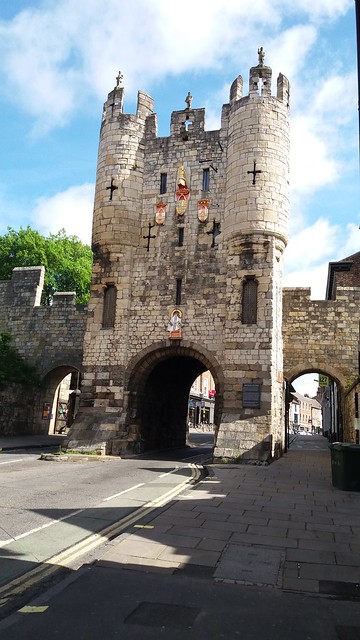
Talking of doing things differently - this is Micklegate Bar. It's one of the ways through the old city walls. (Incidentally, York has one of the most complete, original medieval city walls in the UK.) You might think it's called Micklegate because it's a gate, right? Well it isn't. Gate means street. Bar means gate. And mickle means small. So this is Little Street Gate. 

The Shambles
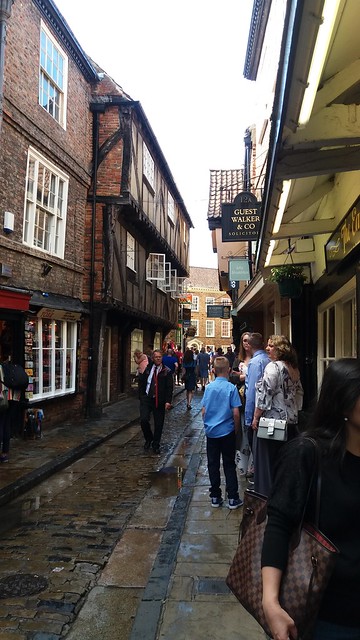
 The Shambles is one of York's best known streets. It has lots of claims to fame: Europe's most visited street; Europe's best preserved Medieval street; and most recently, the inspiration for Diagon Alley in the Harry Potter films. In fact you can hear lots of different languages as you walk along the narrow way: you don't understand a word until someone says "Diagon Alley", then continues talking in whatever native tongue they're using.

The word Shambles originates from the Medieval word shamel, which meant booth or bench. The street was the home of the butchers of York and the road has deep channels at each side where water could be sluiced through to wash away the blood and waste.

The street is so narrow, and the buildings overhang so far, that it's possible to shake hands across the road from the upper storeys.

Clifford's Tower
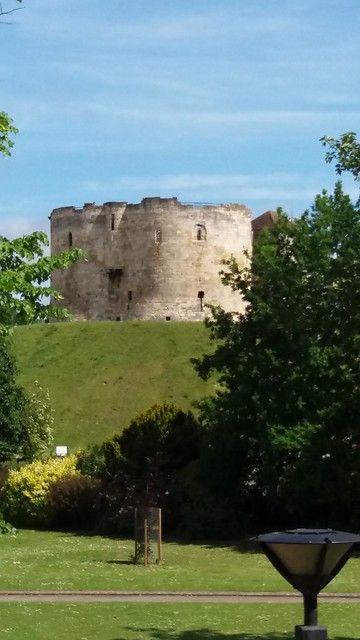
Clifford’s Tower is one of York's best known landmarks. It is part of the old York Castle, once the centre of government for the north of England. It's a motte and bailey structure: the motte being the steep mound and the bailey being the flat area around the mound. Originally there was an 11th-century timber tower on top but it was burned down in 1190, when York’s Jewish community, some 150 strong, was besieged by a mob and forced to seek refuge inside. They committed mass suicide. The present limestone tower dates from the 13th century and was surrounded by a moat

The views from the top are stunning, although tourists don't care about walking in front of you while you're trying to capture it on video. And they seem to ignore the 'one way system' signs on the narrow, spiral staircases. Ho hum.
Romans
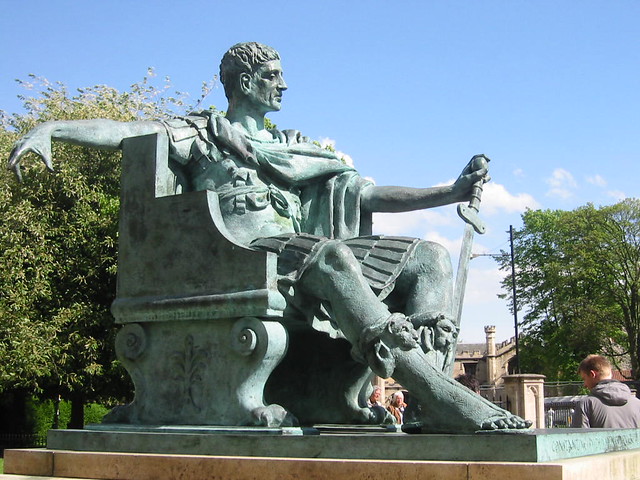
Lastly we're going back in time and forward at the same time. York was, of course, established by the Romans, who called it Eboracum. There are still remnants of the old Roman town. Stonegate, for example, has the original Roman street below it and anyone having to dig up the road soon finds Roman masonry. There's a Roman pillar stands opposite the Minster, marking the site of the basilica. It was found during repair excavations at the Minster in 1969 and erected nearby. Between the pillar and the Minster is one of my favourite public sculptures in the whole country. It's Constantine the Great by Philip Jackson; a life size bronze of the Emperor sitting in an elaborate chair and holding a broken sword. Constantine was declared emperor in York in the year 306.

OK so now you have to go and visit the wonderful Tricky over at FAST blog to see what other fives people have collected this week. 

April 29, 2016

5 more Romans

It's Friday again, so we're off to meet Amy at Love Made My Home for her Five on Friday feature. You might think after my Lincoln trip a couple of weeks ago that you've seen all there is to see about the Romans, but no. Here's some examples of Romans in Rome - well close to Rome, anyway.

The town of Ostia was ancient Rome's coastal resort and major port. Today it has been largely excavated, and extensively reconstructed, so you can wander around it and imagine what life must have been like all those years ago.

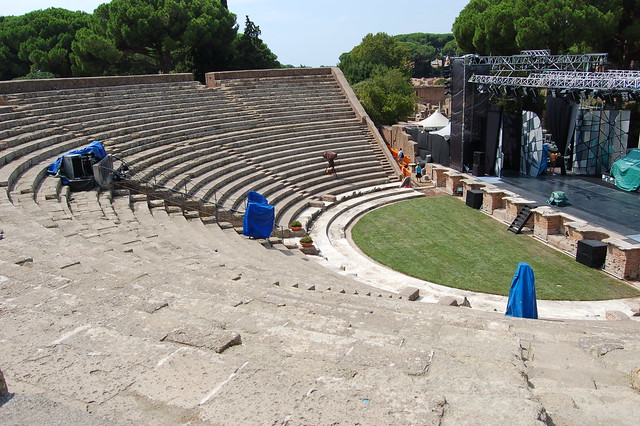
One of the most reconstructed areas is the old theatre. Plays are still staged here (or should that be staged here again?) and the staff were preparing it for a production when we visited - hence all the blue drapes and scaffolding.  The audience sits on the tiers around the auditorium, of course. I imagine it's pretty uncomfortable, unless you take plenty of cushions!

This is the house of the doli. Doli (pronounced dough-lee) were huge storage jars, up to five or six feet high, and they were used by being buried in the ground, making them easier to reach in to and keeping the contents cooler. They could have stored anything - grain, flour, oil, whatever. Imagine a modern 'weigh and save' store.


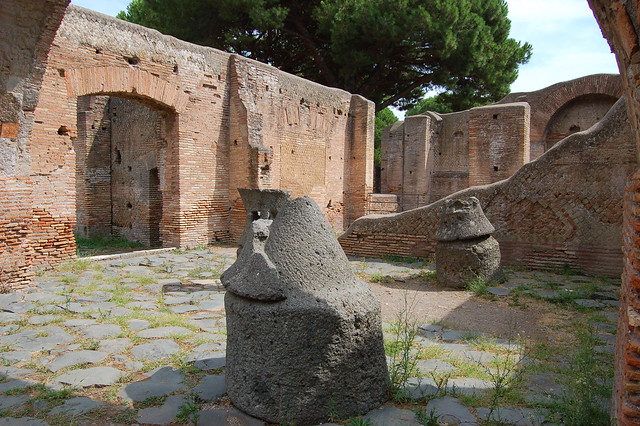
Here's the Mill of Sylvanus. It was a corn grinding mill, and those huge concrete-looking objects are the mill stones. You can just make out the cap on the conical base stone. The holes around the top would have had wooden bars inserted in them so that the top cap could be turned (probably by slaves because there isn't room for a donkey!) to grind flour as corn was poured into the top.

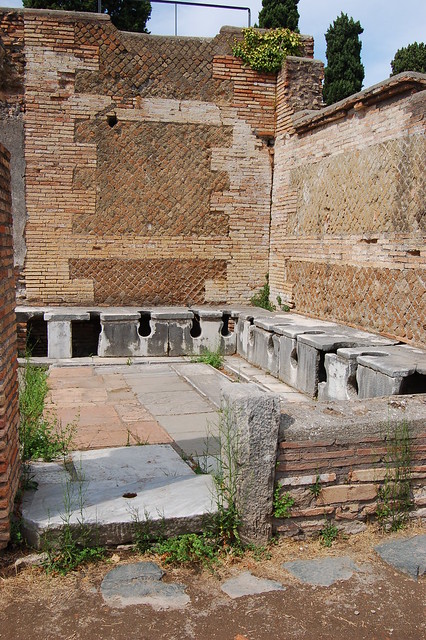
Guess what this is.....   Yes. I'm sure you're right. It's a public loo. Roman latrines were communal affairs where users would sit alongside other participants to complete their ablutions. They also shared the means to clean themselves afterwards. Sponges on sticks were kept in a central pot where they could be rinsed with water before (and hopefully after) use.


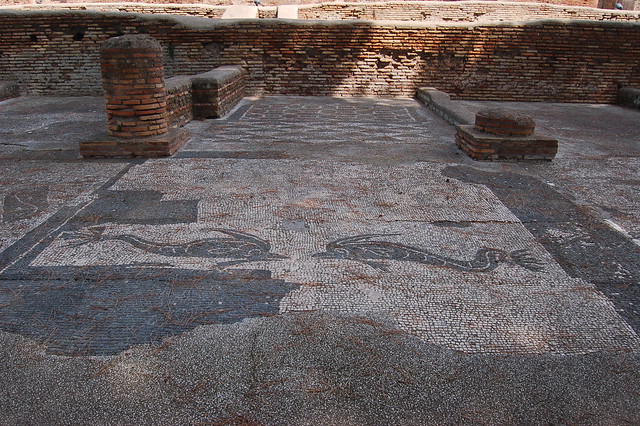
At the heart of town is an area called the Piazzale delle Corporazioni, or Square of the Traders. It is in the form of a quadrangle of small units with mosaic pavements outside them advertising their wares. This must have been a fishmonger - but other stores, if their mosaics are to be believed, dealt in such exotic stock as elephants!

So there is a brief introduction to Ostia Antica. Now pop over to see Amy and find other people's fives. Just click on the photo below.


April 15, 2016

Five on Friday: The Romans in Lincoln

For Amy's Five on Friday this week we're going back to Lincoln, this time to look at the Roman remains.  Don't forget after you've looked at this to visit her site Love Made My Home and see what other people have to offer.

I'm not going to write much historical about these photos.  I already did a fuller post on my other blog with more history included. You can see that here if you want to.

We were staying at the Lincoln Hotel, but back in the days when I lived in Lincoln it was called the Eastgate.  That's because the remains of the city's old East Gate can be found right outside it.


Don't ask about the hotel. The term 'spoiled for a ha'porth of tar' comes to mind. However, Here's the old East Gate - or its foundations at least. It was a very impressive two-storey structure in its day, with semicircular towers on each side. These are the remains of one of the towers.


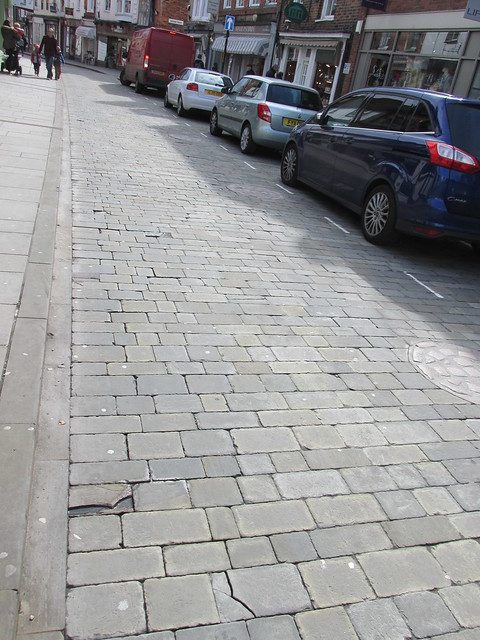
This is rather cool. If you look carefully you can just make out - along the edge of the cars - a row of circles set into the road surface. (The street's called Bailgate.) These circles mark the positions of the pillars across the front of the old Roman Forum. I've seen models and drawings of fora before, but I've never really grasped how big they were until I saw this.  It's a great way of bringing the old town to life.


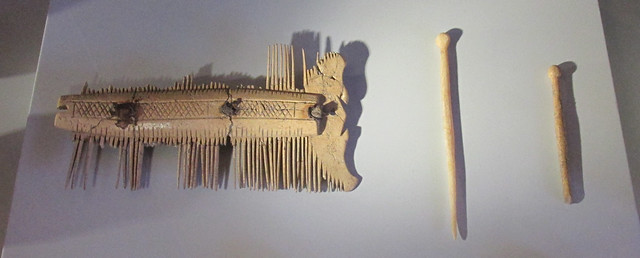
This was one of my favourite discoveries while we were there. The castle has had a massive makeover since my day. Back when I worked as a journalist on the Lincolnshire Chronicle I used to cover the coroner's court hearings. Imagine my surprise to discover the court room is now the castle gift shop! However, the rest of the building has been updated and now includes a fascinating museum section with artefacts that have been dug up on site.  Here are a couple of them - an antler comb and a couple of bone hair pins.
I love this kind of item when I see them on display. A comb is so personal. I can imagine a Roman lady dressing her hair (or allowing her slave to dress it for her) and laying this down onto a table, or placing it into a box until it was needed again.


Fancy having this in your back garden! It was originally part of a reservoir, or water tank, that's believed to have served the local bath house. It had hefty foundations and was lined with waterproof cement. It's tucked away down a narrow street and I had no idea it existed, even though I lived about 300 yards from it for six months!


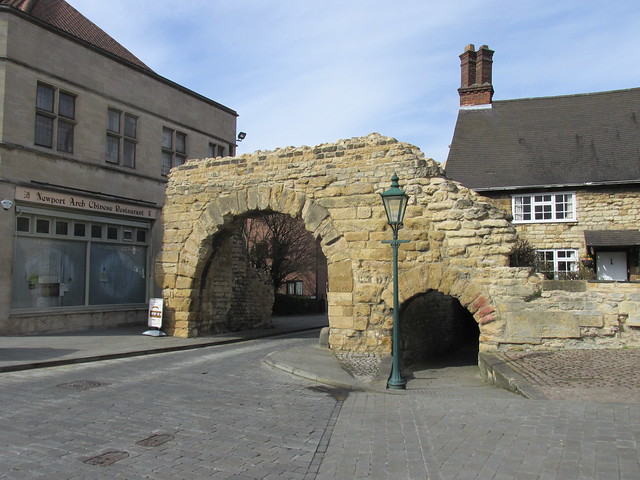
And this is possibly Lincoln's Roman pride and joy. It might not look much now, but it was a significant gateway into the town and crossed the old Ermine Street - the York to London route. It's the only Roman arch in the UK that's still open to motor traffic. (All those bits in York are later sections of the city walls.) This is Newport Arch and I think it's wonderful.

The wall in the previous photo is about six houses down on the right of this picture. And I lived a similar distance off to the left. (In Cecil Street, for anyone who knows the area.)


Now visit other people at Amy's Love Made My Home by clicking on the picture below.