When was the last time you looked at a brick wall? I mean really looked at it. I know what you're thinking: "Why would I?" Well, there's a lot more to brickwork than you'd realise. Anyone who has heard the story of the Three Little Pigs knows that bricks create a safe and stable structure in which to live or store goods. But over the millennia of their history they have often been much more than that.
Back in Tudor times bricks were the preserve of the rich. The amount of work involved, in preparing the clay, shaping individual bricks, and firing them, made them an expensive material. Noblemen across England showed off their status by investing in vast brick mansions, often with contrasting-coloured patterns built in.
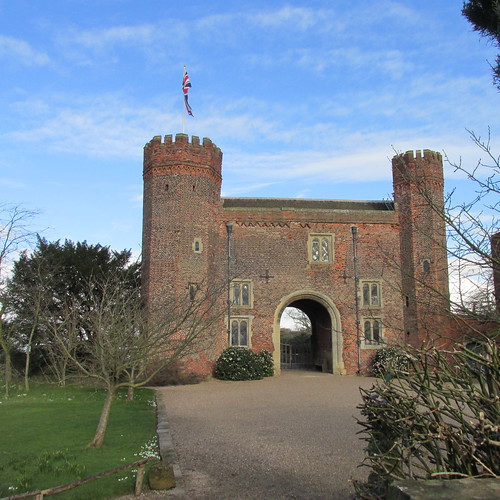
This is the gateway at Hodsock Priory near Blyth in Nottinghamshire. It dates from the early 16th century and gives a hint of how magnificent the actual house must have been. In spite of the name, Hodsock was never a Priory. The current house is a Victorian replacement, unfortunately.
Bricks have various specialist terms connected to them. For example, the long sides are called stretchers. The short sides are headers. The right-angled edges are called arisses. The dent where the mortar goes is called a frog. The brick height is called the gauge. Tudor bricks are typically much shallower gauge than modern ones.
Bricklaying patterns - or bonds - have changed over the years. For example, modern brickwork tends to be what's known as stretcher bond, where all the long edges face the front.
This mostly came about because of the advent of double skin houses with a cavity between the two walls. The idea was that an air gap would help insulate the house, because air is a poor conductor of heat. But the popularity of cavity wall insulation a few years ago has shown that wasn't true.
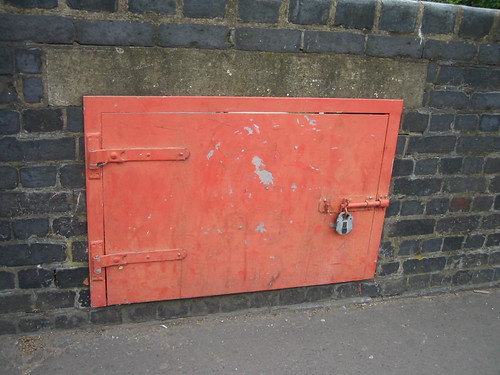
Earlier construction used different patterns. This, for example,
is a classic Victorian era bridge over the canal system in Birmingham. (The gate is to allow fire fighters to put hoses into the canal to use them as a water source.) You will notice that the bricks are in alternate courses of headers and stretchers. This is known as English bond. The wall is, of course, two bricks wide because the headers are twice the length of the stretchers. Other bonds include Flemish, which consists of rows of alternate headers and stretchers, with the headers centred on the mid-point of the stretchers,
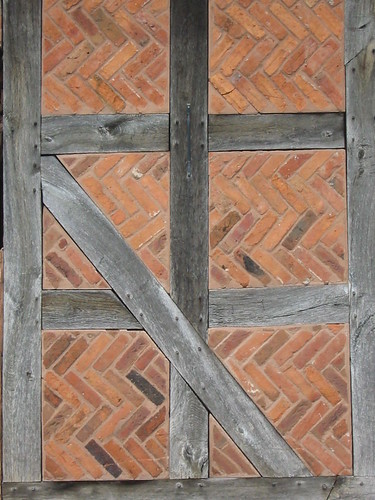
Here's another pattern - called herringbone. As you can see it's the infill in a half-timbered house. This was a Tudor way of having bricks more cheaply than using them for the whole wall. The infill is called nogging. Aren't brick words wonderful?
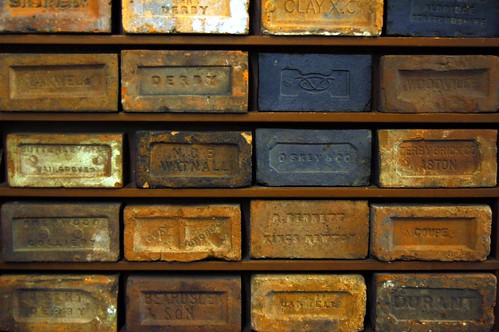
And finally we come to what is possibly the most interesting thing about bricks altogether. Some of them have names!
This collection can be found at Derby Silk Mill Museum and shows just a few of the makers who could be found in the area. As you can see, the names are mostly in the frog, or are on the surface that will be cemented against the next course. Not every brick has a name, and a very few have it on a surface that will be visible. And that's where the fun comes in. Sometimes you can find a name on a wall that tells you where the bricks came from. Like this:
(Bonus photo.)
Today's post has been created for
Five on Friday.