Hello and welcome again to Five on Friday, which is the brainchild of Amy at Love Made My Home. Don't forget to visit her blog to see other Friday Fives when you're done here.
Let me start with an apology. I shall be away from my computer for quite a lot of this week, so I might not get back to comment on your blogs as quickly as I'd like. But I'll do my best. I'm also short on time now, so I've dredged my Flickr stream to find something you might enjoy seeing.
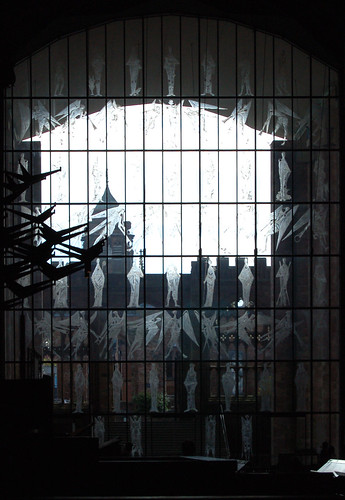 |
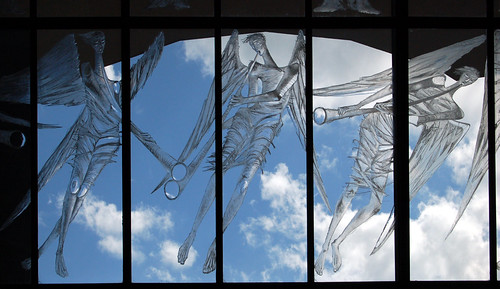
| West window by John Hutton |
Many years ago I visited Coventry, and my Dad and I went to see the cathedral. (Some years later, but still a long while ago, I ended up living in the city, but that's another story.)
Coventry was devastated during WWII by a German bombardment on the night of 14 November 1940, and its medieval cathedral was almost totally destroyed by incendiary devices. The Allies knew the bombers were coming, but nothing could be done to prevent the attack because the information had been gathered from a message sent in the Enigma code. The British had only just broken the code (Yes, my American friends, in spite of what you've seen at the movies, it was a team of Brits who broke Enigma.) but we couldn't afford to let the Germans know. It was felt that much more useful information might be gleaned from future messages, so Coventry was sacrificed.
Out of the wreckage, many years later, a phoenix was born, in the shape of the new Coventry Cathedral. The new building stands to the side of the remains of the old, forming a symbol of resurrection. (Note - I'm not a christian, but you can also spell that with a capital R, if you're that way inclined.) It incorporates some significant examples of architecture and art.
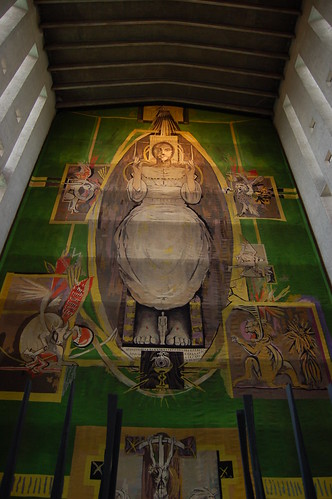 |
| Graham Sutherland tapestry |
This is the extremely famous altar tapestry designed by Graham Sutherland. To give you an idea of its impact, the figure between Christ's feet is human sized. I remember my Dad's comment, that within the work there were some decent pictures trying to get out.I'm not sure I felt quite so unimpressed as he was, but I know what he meant.
 |
| Angels detail |
At the opposite end of the building is the magnificent window you can see in the top photo, designed by John Hutton. It forms the link between the old and new buildings. You can just make out the old ruins in that photo. You can't see the angels properly though, so I've put a detail in here as well.
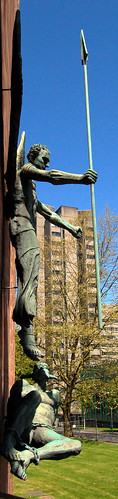
This is a rather unusual view of the Jacob Epstein sculpture "St Michael's Victory over the Devil". The 1958 bronze has come under fire in the past. Epstein sculpted the Devil with distinctly negroid features and the work has been accused of racism. However, Epstein was Jewish and was the target of a fair amount of racism during his lifetime. I'm not convinced that any slur was intended, but I admit I don't know enough about it to be sure. He was known for challenging accepted ideas and frequently depicted different forms of sexuality in his works. His private life wasn't exactly conventional either. It's possible that his negro Devil was just another way to challenge ingrained thoughts. Whatever, there's no arguing that he was a talented sculptor.
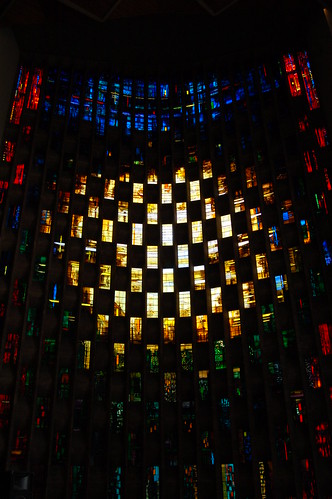
This is the magnificent baptistry window designed by John Piper. This photo doesn't do it justice. It's huge - on a similar scale to everything else in the building - and it really comes into its own when the sun shines. Coventry's an odd cathedral. When you walk into it there's very little light and colour except for the tapestry at the far end. It was designed (by Sir Basil Spence) with curious zig-zag walls so what you see in front of you is a series of concrete folds. However, when you get to the altar and then turn back you find that each of the folds hid a full height stained glass window in similar style to this one.
It's stunning.
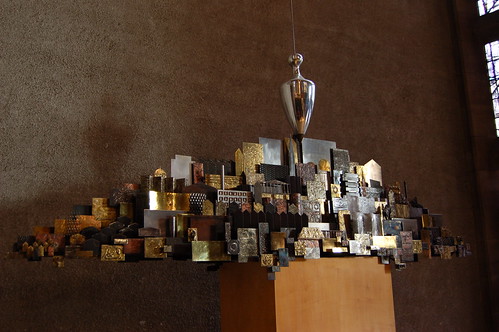
And finally, this is a sculpture called The Plumb Line and the City. It's by Clark Fitz-Gerald and symbolises god's way of testing the city to see if it's 'straight and true'. I was delighted after posting this photo to Flickr to receive a message from the artist's son asking for a copy of the picture. Praise indeed!