Well done to anyone who understands the title of this post. It probably means you won't learn much from it - because you're already in the know!
In this week's Five on Friday - to join in with
Amy at Love Made My Home - we're going for a wander by the canal. Britain's canal system was the 18th century equivalent of today's motorways. They carried most freight, and often carried people too. Even at four miles an hour (walking pace) it was often faster (and definitely smoother) than travelling by road.
So let's start with some boats.
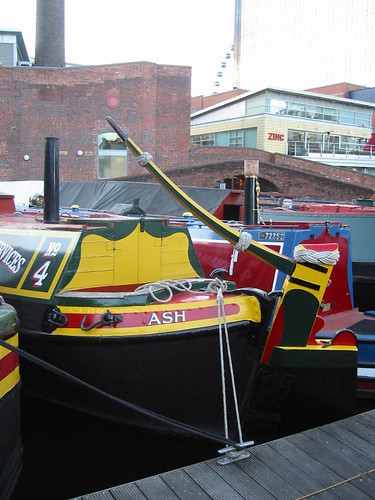 |
| Narrow boats in the heart of Birmingham |
Canal boats were also known as narrowboats. There's a reason for that. Most of them were no more than seven feet wide and the gauge was determined by the earliest engineers who designed the canals to be not much more than 15 - 20 feet wide. Why? Well, every yard of the 2,000 plus miles had to be dug by hand. And when they were complete they had to be supplied with water. Imagine you make the canal just three feet wider: that's 95,040 cubic feet of soil and rock to remove for each mile; and 592,000 gallons of water to find to fill it back. So they built them narrow.
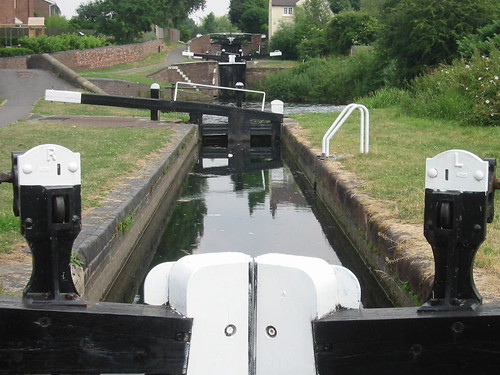 |
| A lock flight at Stourbridge |
The engineering involved in getting up and down hill was pretty tough too. That meant building locks; a complex means of raising and lowering a body of water, in a block, with a boat floating on top. The earliest locks, on James Brindley's 1769 stretch of canal, from the coalfields of Wednesbury to the heart of Birmingham, were made to take only one boat at a time - to simplify the required engineering work.
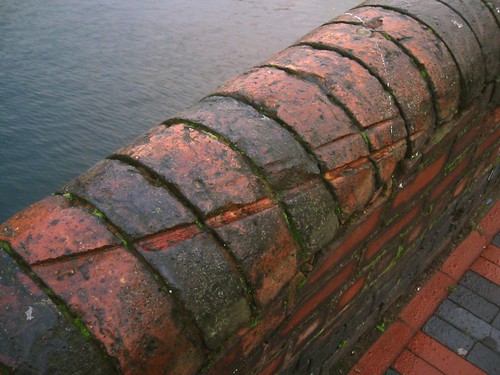 |
| Rope wear |
Of course the earliest boats weren't mechanised. They were hauled by heavy horses, by means of long ropes. The ropes were often wet because they had dragged into the water and then they picked up sharp stones and clinker from the towpath as the bargees made their way along. This turned them into very effective rasps, and you can see evidence if you look carefully. The photo above shows rope wear on a bridge parapet where boats turned a corner. (Think about the horse in front, turning right to cross a bridge to make its way onto a branch canal. As it goes, the rope is pulled across the brickwork, scraping away the top surface. The boat is dragged around the corner and continues along the way.)
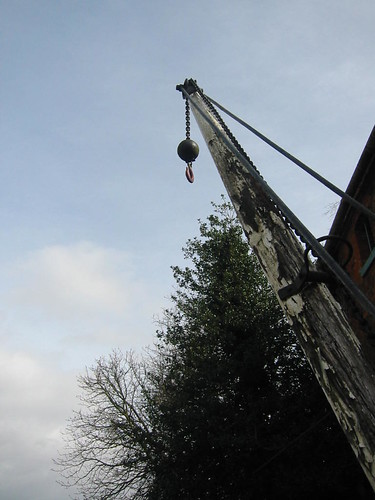 |
| Canal crane |
Let's not forget that canal life was tough. The bargees transported goods for hundreds of miles, loading and unloading heavy cargoes at each destination. To help them with the task warehouses had canalside cranes and a very few still exist today. The pictured one, at Shardlow in Derbyshire, sadly doesn't exist any more. The metal work at the bottom (that lifted and turned the arm) is still there, but the woodwork became so rotten that it was removed some years ago for safety's sake.
 |
| Measham ware pots |
And at the end of the day the boat families were grateful for a pot of tea. Often the bargees owned a magnificent, colourful pot made near the town of Measham in Leicestershire. The decoration often marked an important family event, such as a birth or marriage, and the pots were treasured heirlooms.
So that just leaves the post title. "Gongoozlers" is a canal word for people who stand around watching the boats pass while other people do the work! It's a pleasant way to spend an afternoon.
Right. Off you go
over to see Amy to find out what other Fives have been posted this week.
