Showing posts with label garden history. Show all posts

April 28, 2017

Brodsworth

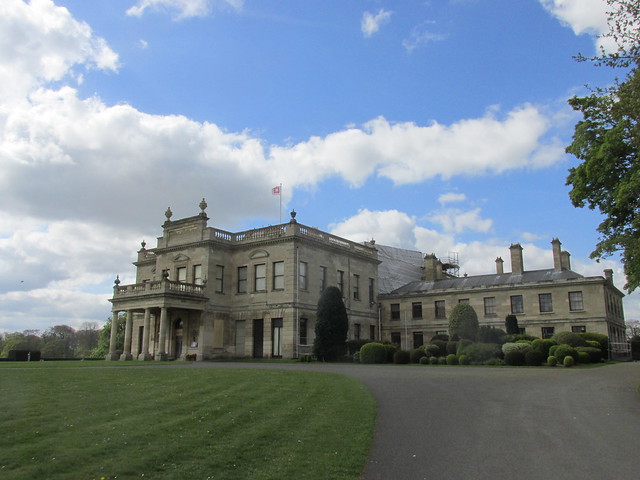
Brodsworth Hall - note the scaffolding
Just outside Doncaster there's a magnificent Victorian pile called Brodsworth Hall. To cut a long story short it fell on hard times after WWI and began to crumble gradually away so that, by the time English Heritage took it over in the 1990s, it was a faded remnant of its former glory.

In opposition to how most heritage organisation behave, EH decided to consolidate it 'as found' rather than restoring it. Today it's in the middle of a massive project to make it safe and suitable for visitors. It's wrapped in scaffolding and largely sheathed in plastic.

The gardens, however, are magnificent. Glorious sunshine gave me the chance to wander round and see them in their full wonder.  Here's some photos:
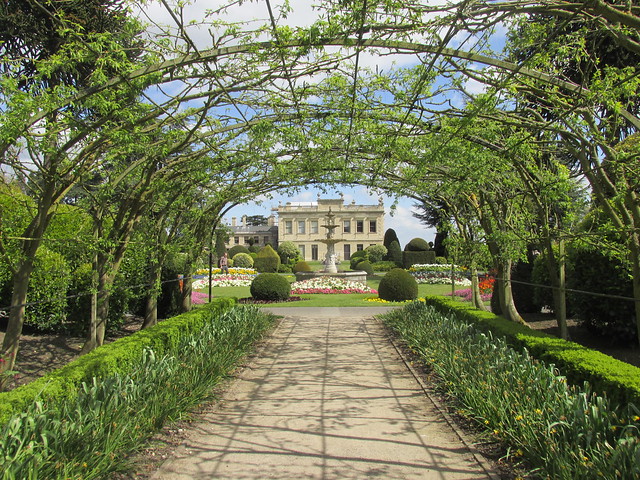
View to the hall across the fountain garden from under the laburnum arch. I'm determined to go back and see it when it's in flower. End of May should do it.
Round the back of the hall is a sweet little pet cemetery with carved headstones for the various animals. One says simply 'Polly parrot' while others give hints such as 'good boy', so I'm assuming that was a dog. There are no clues as to the species of Binkie Pippy, however. Sounds like a bunny to me!

The grounds are scattered with statuary and ghostly white figures in various degrees of dress stand around looking classical. I kind of liked this young lady feeding the pigeons. 

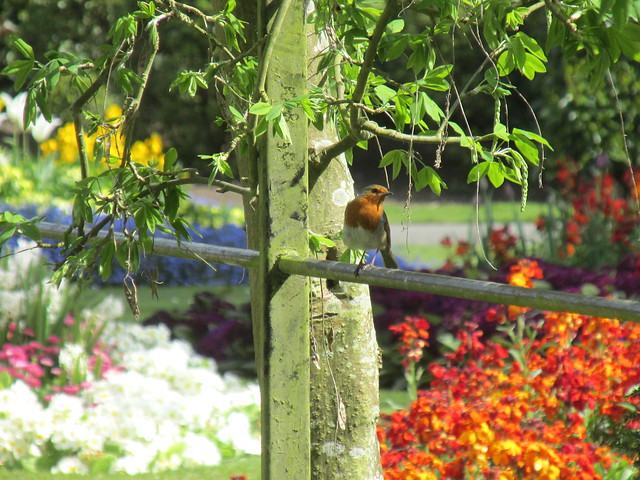
And then there was the real wildlife.  You get a hint of the colour from the fountain garden in this shot so the delightful robin isn't easy to spot, but he sat there singing his heart out for a while and seemed happy to have his photo taken. 

Now off you go over to Tricky's FAST blog to see the other Five on Friday posts. Happy weekend all. 

July 15, 2016

Melbourne

Bit of a lazy Five this Friday. If you read my other blog you'll know I did a post about a beautiful wrought iron arbour in the garden of Melbourne Hall in Derbyshire. It, and several other garden structures, are listed Grade I because of their historic importance. (Read the History Anorak post if you want to know why they're important.)

So anyway, I thought you might like a look at some of the other garden ornaments at Melbourne and that's this week's post. But I can't be bothered re-writing the information on them, so I've just cut and pasted the official listing from Historic England.


Perseus
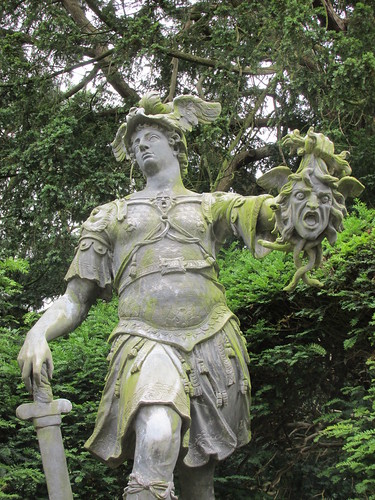
Pedestal with Statue of Perseus in Melbourne Hall Gardens. Pedestal with statue of Perseus, c.1700 by Jan van Nost. Erected as part of a French-style garden, designed by Royal Gardeners to Queen Anne, London and Wise, for Thomas Coke of Melbourne Hall. Stone and lead. Panelled stone pedestal on wide square plinth with life-size figure of Perseus holding Medusa's head, clad in Roman style armour with winged sandals and helmet.

Covered seat
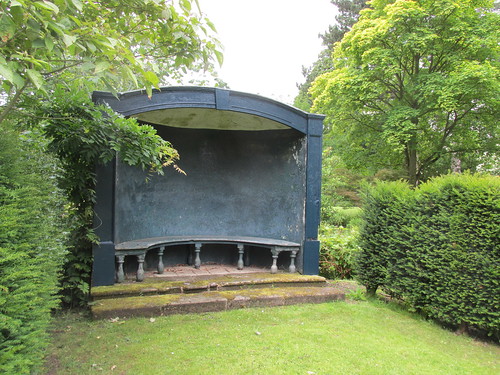
Covered Seat to East of Fountain Pond in Melbourne Hall Gardens (formerly listed with the matching seat as 'Two Alcoves in grounds of Melbourne Hall') Covered garden seat  c.1704 with later repairs. Work carried out by William Cooke of Walcot. Stuccoed brick and timber. Curved timber bench on turned legs fitted into an apsidal structure with stuccoed segmental brick wall covered by domed lead roof, with simple panelled timber jambs and segmental cornice with raised keystone. Built as a pair to similar seat to west.

Fighting cherubs

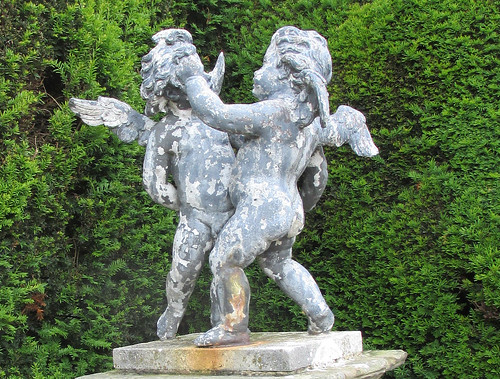
Two Pairs of Cherubs to South-West of the Grand Basin in Melbourne Hall Gardens (formerly listed as 'Pair of pedestals with figures of fighting cupids on south side of garden, Melbourne Hall') Two pairs of cherubs, c.1700 by Jan van Nost. Stone and lead. Each pair of cherubs stands on a panelled stone pedestal with moulded base and cornice. Western pair are kissing and eastern pair are fighting. These form a group with another two pairs of cherubs on the opposite side of the basin and tell the tale of Castor and his brother Pollux fighting over a bunch of flowers and their eventual reconciliation.

Four Seasons Vase

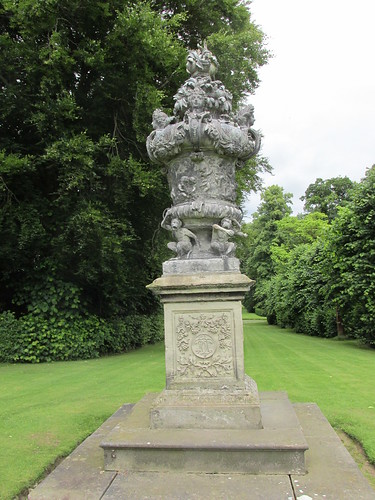
Pedestal and Four Seasons Vase in Melbourne Hall Gardens. Pedestal with vase, 1705, vase by Jan van Nost and pedestal by Devigne. Stone and lead. Panelled pedestal with moulded base and cornice on stepped square plinth, each panel carved with foliage and swags and with central roundels inscribed 'TC'. Magnificent baroque lead vase over supported by four seated lead monkeys, with gadrooned base to bowl and stem of bowl decorated with frieze of putti and foliage swags. Lid with bulbous base has four scrolled handles, each topped by the head of a Season, with panels between and more swags. The top is surmounted by a lattice work basket bursting with fruit and flowers. The vase was presented by Queen Anne to Thomas Coke.

Sets of steps

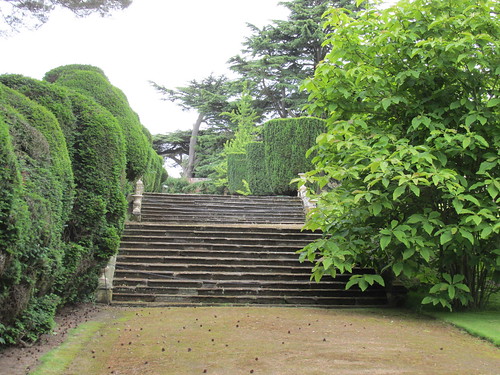
Five Flights of Steps between terraces at Melbourne Hall Gardens . Five flights of steps c.1704 with later urns. Work carried out by William Cooke of Walcot. Stone. Two flights of steps to either side of terrace and one central flight. Each flight has ten steps with moulded nosings and low retaining walls to either side terminating in low square piers to either end. The piers are now topped by later gadrooned urns. Each top step is wide and has diamond patterned paving.


Now take a trip over to see Amy at Love Made My Home and find out what other Friday Fives have been submitted this week.

May 13, 2016

Five Flowers for Friday

There's rosemary, that's for remembrance. Pray you, love, 
remember. And there is pansies, that's for thoughts.
There's fennel for you, and columbines. There's rue for you, 
and here's some for me. We may call it herb of grace o' Sundays. 
O, you must wear your rue with a difference! There's a daisy. I 
would give you some violets, but they wither'd all when my father 
died. They say he made a good end.

Of course Ophelia was quite mad, and grieving over her father's death, when she made this speech in Hamlet, but the fact that Shakespeare included such a rich and symbolic reference to flowers shows how important they were in Elizabethan culture.

I made a recent visit to Kenilworth's Elizabethan Garden and covered the archaeological and historical background in my other blog. What I didn't say much about was the variety of flowers and plants I found there.

The idea of using flowers as symbols goes back as far as the Old Testament of the Hebrew Bible. By Elizabethan times the social norms of the day prevented normal communications, particularly between potential lovers, so much was said using the code of floriography, or the language of flowers.

Robert Dudley's great garden of love has been reconstructed using contemporary sources to ensure its authenticity. It contains very many 'hidden' messages to the Queen he created it for. Here are some examples:

Let's start with the ones that Ophelia mentions.  First rosemary. Like I said, she was madly remembering her father's death, but in Dudley's case this would have been to tell Elizabeth that she was always in his thoughts.

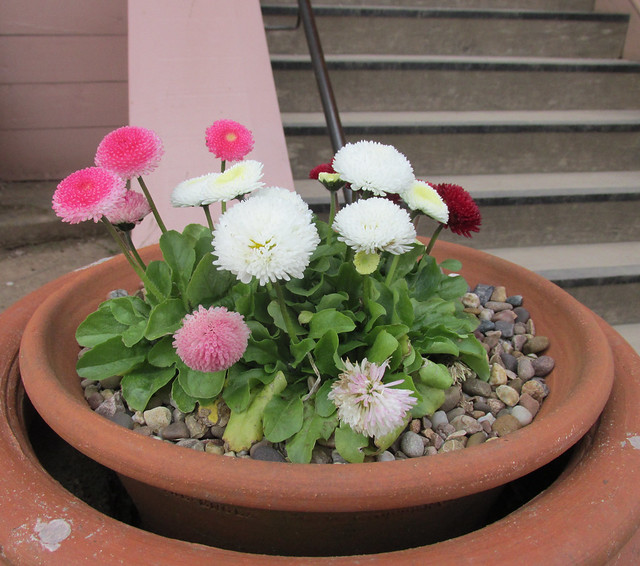
Daisies are a difficult topic because they have very many meanings. They can mean unhappy or forsaken love, as Ophelia implies about Hamlet, but they can also mean innocence. So Dudley could have been praising his Virgin Queen.  And red daisies stand for beauty that is unknown to its possessor. Now there's a bit fat piece of flattery. QEI wasn't exactly pretty, if you study her portraits, but Dudley would have told her she was, as part of his campaign to win power.

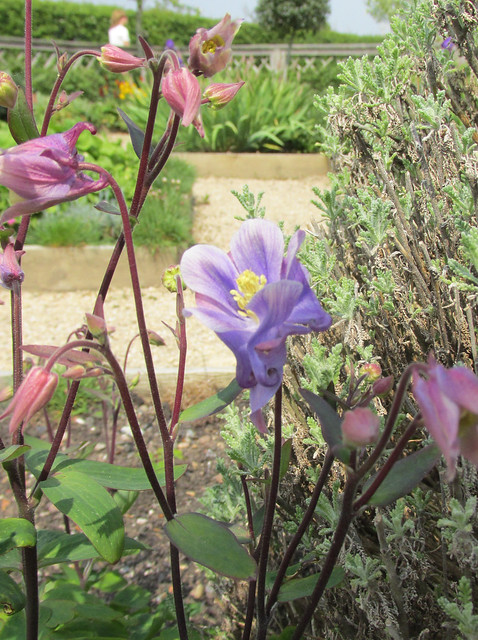
Here's aquilegia, or columbine. This one symbolises innocence as well. Its name 'columbine' derives from the Latin for dove, because the flower is said to resemble four doves. I can't see it, frankly, but there you go. However, there's a religious link to the christian Holy Spirit, which is also symbolised by a dove. Hence purity and innocence.

The grassy bank below the viewing terrace is packed with primroses. Not only does it make for a very pretty sight (there are cowslips in among them too - representing grace) but it also screams "I will love you forever. I can't live without you" to anyone who understands the message. The flower's Latin name Primula means 'the first', because it is among the earliest flowers to appear in spring. But that was also used to imply that a person is 'first' in another's thoughts.

And finally we come to a bit of a cheat, because I'm going to talk about the hedges as one item, even though they have several species in them. Traditionally the hedges around Elizabethan knot gardens would have been box, but its meaning is stoicism, which isn't too romantic. True, Dudley had to be a bit of a stoic to keep up his pursuit of the queen's hand for as long as he did, even though he never succeeded, but that wouldn't have been too complimentary to her.  So the hedges at Kenilworth include hawthorn and holly. Hawthorn stands for hope and holly for domestic happiness. How clear a message is that?

I've done a bit of research for this post, not just at Kenilworth itself but also online. Thanks to Wikipedia (as ever) but also to this page which refers to “The Garden of the Renaissance: Botanical Symbolism in Italian Painting” by Mirella Levi D’ancona.

Thanks as always to Amy at Love Made My Home for organising the Five on Friday .  Take yourself off there to see what other people have to offer. Click here to be taken there.


January 30, 2016

Small world

As I said in my last post I decided at the start of this year to study garden history. Thing is, I've encountered a name that I didn't expect to. One of my colleagues once told me that his ancestor was quite a well known architect (though I'd never heard of him). It turns out that he's more recognised for the gardens he designed alongside his houses. I've found his name in several places now, and he's responsible for a few gardens I've actually visited in the past. Ho hum. 

January 28, 2016

Who knew?

My new year's resolution was to start studying garden history. January isn't the best time to make that kind of decision, unless you live in Australia, of course. But I don't.
Recently I found myself wandering in the grounds above the Spa in Scarborough. To be fair, I get to Scarborough quite a lot, but I rarely visit the Spa end. I took the opportunity to take a stroll through the Italian Gardens, which are part of the South Cliff Gardens area. To get there I passed through what's known as the 'historic Victorian rose garden'.
For someone at the very start of studying garden history it was an informative day. For example, I had chance to get a good look at the layout of the rose garden beds without the hindrance of all those bright flowers to obstruct the view. (And I've got a good excuse to go back in the summer and see it in full bloom.)
Turns out that the winding paths leading down the cliff side, that we followed from the Esplanade to the foreshore, were laid out by Sir Joseph Paxton in the 1850s to rectify a landslip that swamped the back of the Spa buildings. Who knew?
Well, I do now, and I'll have a deal more studying to undertake as a result.