A few weeks ago I had to visit Leicester for a meeting and on my way back to my car I passed the city art gallery in New Walk. I had a spare 20 minutes so I nipped in for a quick look. Here's a selection of what I found. Sorry about the quality of the photos - I took them with my phone.
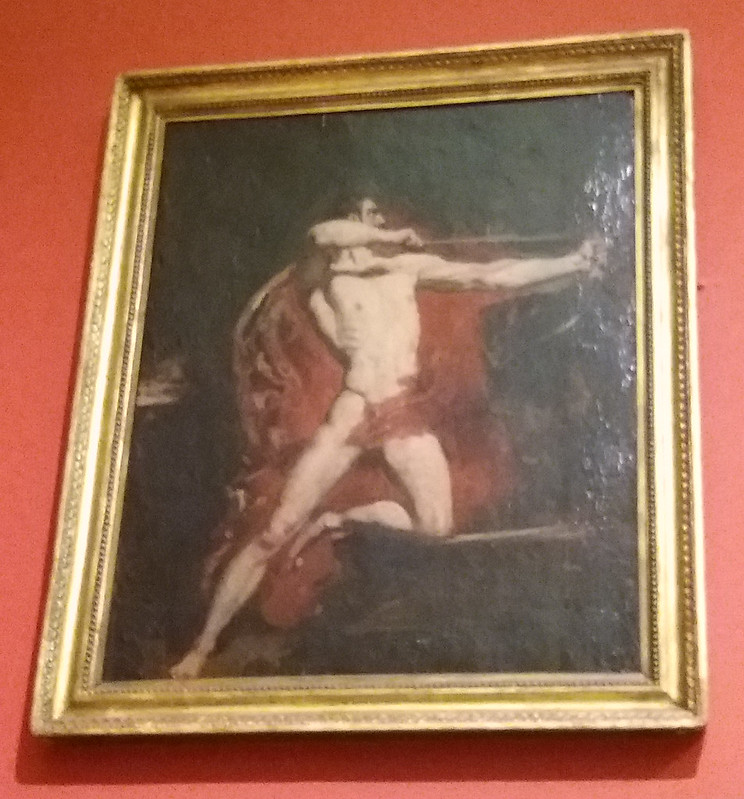
The Bowman, oil on board, painted about 1825-30. It's by William Etty, (1787 - 1849) who was known for his landscapes featuring nudes. There's a larger version of this in York City Art Gallery, that shows more of the landscape, but still doesn't identify what he's aiming at. Etty was born in York and the gallery has a number of Etty's paintings.
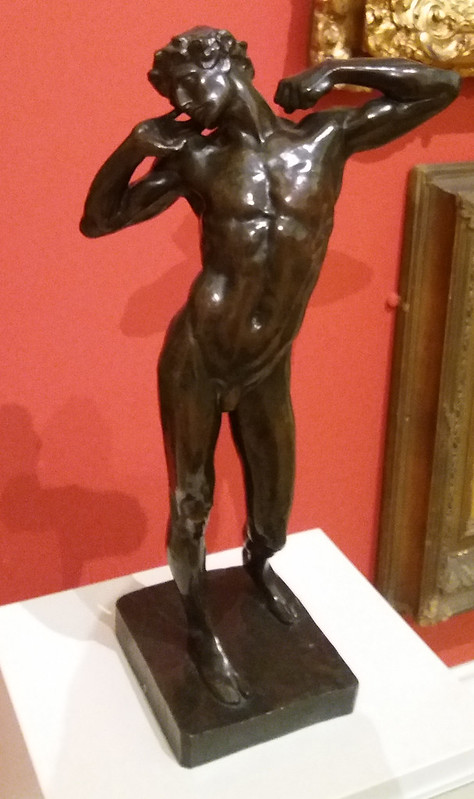
The Sluggard by Frederick, Lord Leighton. Bronze, cast in 1890. Leighton (1830-1896) was a painter and sculptor who became president of the Royal Academy in 1878. This bronze was a small version of a life-sized work that now stands in Tate Britain.
Head of an Arab, oil on canvas, painted 1857. Believed to be a preparatory work, designed to perfect the head before including it in a larger work. Also by Lord Leighton.
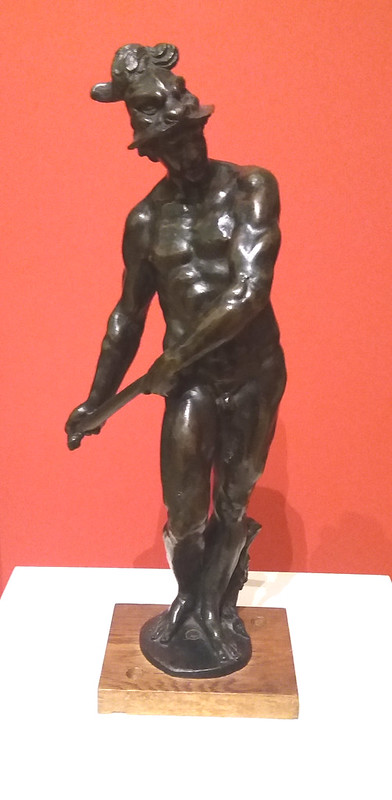
Vulcan - no, it's nothing to do with Mr Spock - a bronze by Tiziano Aspetti (1565 - 1607). Aspetti worked mainly in his native Padua, and Venice. The small figure shows the Roman god of blacksmithing, fire and volcanoes, hence his powerful build and strong arms.
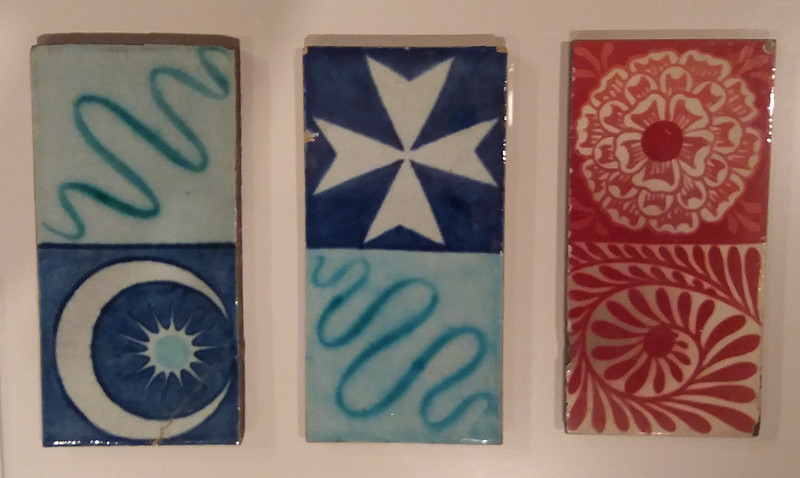
And for something different, I found a small exhibition of works by the artist William De Morgan (1839 - 1917), a lifelong friend of designer William Morris. These hand-painted, ceramic tiles are believed to have been designed as part of a commission for P&O Ships for interior decor.
Now off you go to Tricky's FAST blog to see what other Five on Friday posts there are.
Some chat about historical things. Some of it is inspired by topics on the associated History Anorak blog.
Showing posts with label sculpture. Show all posts
March 31, 2017
February 03, 2017
History sculptures
One thing I love is public sculpture that is, things that you find on the street, or the side of buildings, rather than having to go into a galery or museum to see.
Here, for Five on Friday, are a selection of statues or sculptures that commemorate something historical.
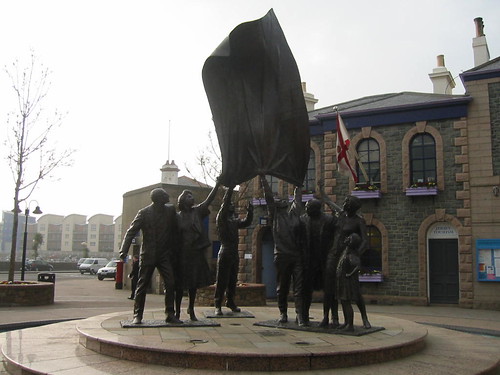
Jersey was the only part of the British Isles to be occupied by Germany during the second world war. This is a sculpture commemorating the liberation. It stands in a square in St Helier where the advance parties of the Royal Navy and British Army landed to drive out the German forces.
The design met with severe criticism from some sources because it shows a group of figures releasing doves of peace. any pointed out that conditions under German rule had been so strict that people were close to starvation and any doves on teh island would have been eaten!
It's by Philip Jackson. One of my favourite sculptors.
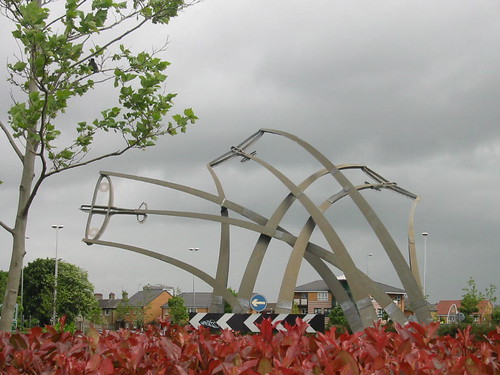
This one stands on a traffic roundabout in Birmingham, outside the Castle Bromwich Jaguar (engine) factory. It's called Sentinel, and it shows a number of Spitfire planes (which had Jaguar engines) taking off. It's by Tim Tolkien, great grand nephew of the Lord of the Rings author.
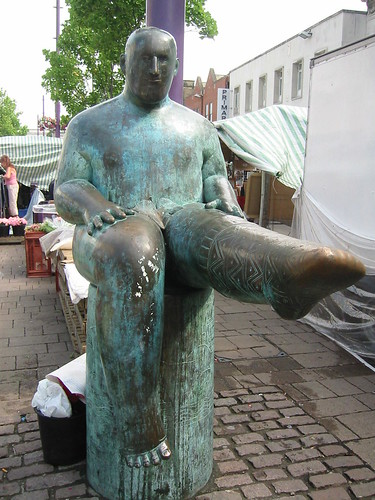
This bronze by Shona Kinloch sits in the market place in Loughborough (which just won an award for being one of the best outdoor markets in the country - and it is) and represents much more than the town's connection with the hosiery industry.
From the national public art record.....
"According to the sculptor, the 'sock pattern echoes the zig-zag of the new bollards in the Market Place, while the surrounding Art Deco buildings (e.g. the Curzon Cinema) inspired his deco hair cut'. On the figure's right arm is an incised tattoo of a heart above the word 'Loughborough' set within a scroll motif. The bollard on which he sits is decorated with incised images from the history of the town: a railway track and train, representing Thomas Cook's first tourist excursion from Leicester to Loughborough in 1842, a canal and barge representing the introduction of the Soar Navigation and Leicester Navigation in the eighteenth century, factories and sheep for the woollen industry, one of local agriculturalist Robert Bakewell's longhorn cattle, bells to represent the town's bell-founding industry, and the towers, etc. of Loughborough University. The sculptor has also commemorated the year in which she began the piece with an image of the Hale Bop comet."
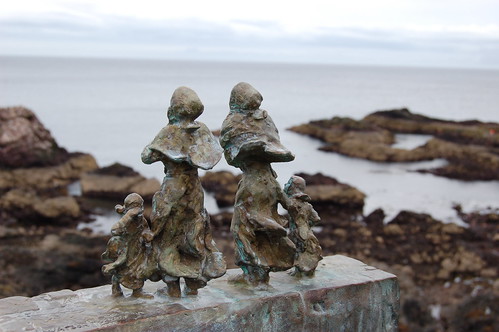
On the night of 14 October 1881 a terrible storm blew up off the east of Scotland that affected almost every fishing village along the coast.
The storm devastated the fishing fleet and 189 fishermen were drowned, many within sight of the shore. 129 were from Eyemouth, 24 from Burnmouth, 15 from Newhaven, 11 from Cove, 7 from Musselburgh, and 3 from Coldingham Shore (now called St Abbs) More than 70 women were widowed and 300 plus children left without fathers as a result.
This is one of a series of monuments that stand along the shore in the villages that lost their men. Erected to mark the 125th anniversary of the disaster. St Abbs Bronze sculpted by Jill Watson.
This photo fails to give any idea of the scale of this piece. It's huge: 35 feet high and 27 feet wide.
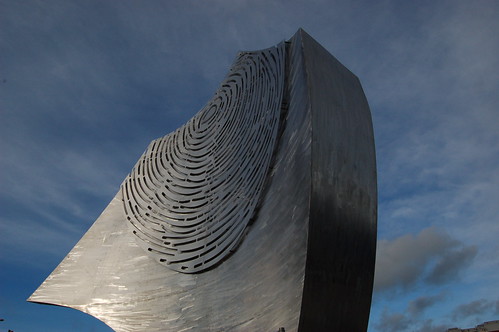
The sculpture in Tunstall, part of Stoke on Trent, stands at the centre of a new shopping precinct, which used to be the site of the old Wedgwood factory. It represents a shard of Roman pottery, carrying the potter's fingerprint, that was found in an underground kiln when the site was redeveloped. Truly this piece marks the centuries of pottery production in the area.
It's by sculptor Robert Erskine who very kindly contacted me after I posted this photo on Flickr wondering why it hadn't been made in ceramic. It wouldn't have worked, apparently, and certainly wouldn't have survived very long. The Tunstall Shard is stainless steel and should be good for a couple of centuries. It's also wonderful.
Here, for Five on Friday, are a selection of statues or sculptures that commemorate something historical.
Jersey was the only part of the British Isles to be occupied by Germany during the second world war. This is a sculpture commemorating the liberation. It stands in a square in St Helier where the advance parties of the Royal Navy and British Army landed to drive out the German forces.
The design met with severe criticism from some sources because it shows a group of figures releasing doves of peace. any pointed out that conditions under German rule had been so strict that people were close to starvation and any doves on teh island would have been eaten!
It's by Philip Jackson. One of my favourite sculptors.
This one stands on a traffic roundabout in Birmingham, outside the Castle Bromwich Jaguar (engine) factory. It's called Sentinel, and it shows a number of Spitfire planes (which had Jaguar engines) taking off. It's by Tim Tolkien, great grand nephew of the Lord of the Rings author.
This bronze by Shona Kinloch sits in the market place in Loughborough (which just won an award for being one of the best outdoor markets in the country - and it is) and represents much more than the town's connection with the hosiery industry.
From the national public art record.....
"According to the sculptor, the 'sock pattern echoes the zig-zag of the new bollards in the Market Place, while the surrounding Art Deco buildings (e.g. the Curzon Cinema) inspired his deco hair cut'. On the figure's right arm is an incised tattoo of a heart above the word 'Loughborough' set within a scroll motif. The bollard on which he sits is decorated with incised images from the history of the town: a railway track and train, representing Thomas Cook's first tourist excursion from Leicester to Loughborough in 1842, a canal and barge representing the introduction of the Soar Navigation and Leicester Navigation in the eighteenth century, factories and sheep for the woollen industry, one of local agriculturalist Robert Bakewell's longhorn cattle, bells to represent the town's bell-founding industry, and the towers, etc. of Loughborough University. The sculptor has also commemorated the year in which she began the piece with an image of the Hale Bop comet."
On the night of 14 October 1881 a terrible storm blew up off the east of Scotland that affected almost every fishing village along the coast.
The storm devastated the fishing fleet and 189 fishermen were drowned, many within sight of the shore. 129 were from Eyemouth, 24 from Burnmouth, 15 from Newhaven, 11 from Cove, 7 from Musselburgh, and 3 from Coldingham Shore (now called St Abbs) More than 70 women were widowed and 300 plus children left without fathers as a result.
This is one of a series of monuments that stand along the shore in the villages that lost their men. Erected to mark the 125th anniversary of the disaster. St Abbs Bronze sculpted by Jill Watson.
This photo fails to give any idea of the scale of this piece. It's huge: 35 feet high and 27 feet wide.
The sculpture in Tunstall, part of Stoke on Trent, stands at the centre of a new shopping precinct, which used to be the site of the old Wedgwood factory. It represents a shard of Roman pottery, carrying the potter's fingerprint, that was found in an underground kiln when the site was redeveloped. Truly this piece marks the centuries of pottery production in the area.
It's by sculptor Robert Erskine who very kindly contacted me after I posted this photo on Flickr wondering why it hadn't been made in ceramic. It wouldn't have worked, apparently, and certainly wouldn't have survived very long. The Tunstall Shard is stainless steel and should be good for a couple of centuries. It's also wonderful.
Labels:
14 October 1881,
Jaguar,
Jersey,
Loughborough,
Philip Jackson,
Robert Erskine,
sculpture,
Sentinel,
Shona Kinloch,
Spitfires,
St Abbs,
Stoke on Trent,
storm,
The Sock,
Tim Tolkien,
Tunstall Shard,
WWII
December 30, 2016
Moths
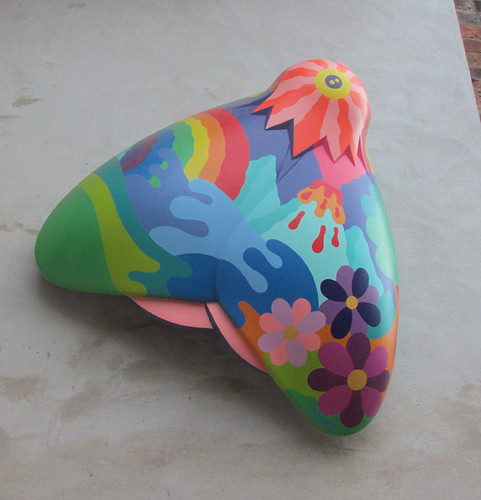
2017 will be Hull's turn as UK City of Culture. It's a well deserved title, because Hull has a lot of public art as well as significant gallery collections. Currently there's a flight of moth sculptures scattered around the city to commemorate aviator Amy Johnson, who was born in the city. For more about Amy click here.
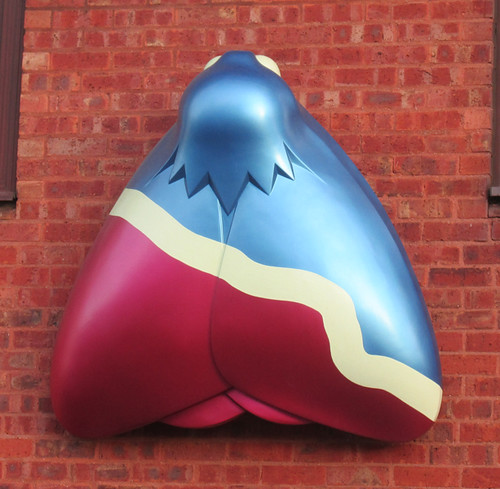
This was the first one we found on our recent trip to Hull. (It's Mr Anorak's home town, of course.) It's called Horizon's Path and was created by artist Sam Tasker. The blue bit represents the freedom of the skies, the maroon bit signifies women's equality, and the white line represents Amy's flight path to Australia.
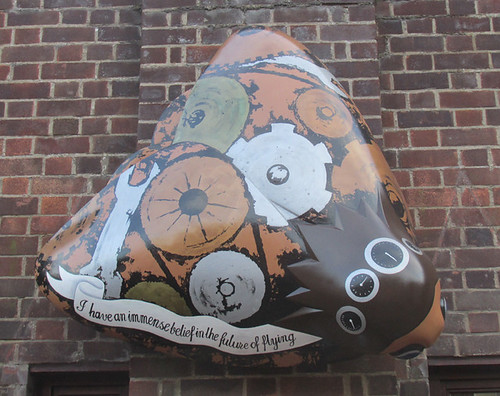
This is called Engineer, and it was painted by Hannah van Green. It's a mark of respect for Amy's mechanical skills.
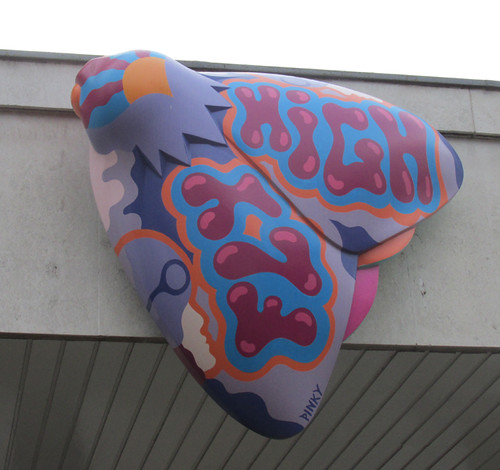
This is World Moth by an artist called Pinky. It's inspired by the fact that Amy flew half way round the world, and represents some of the landscapes she must have passed along the way.
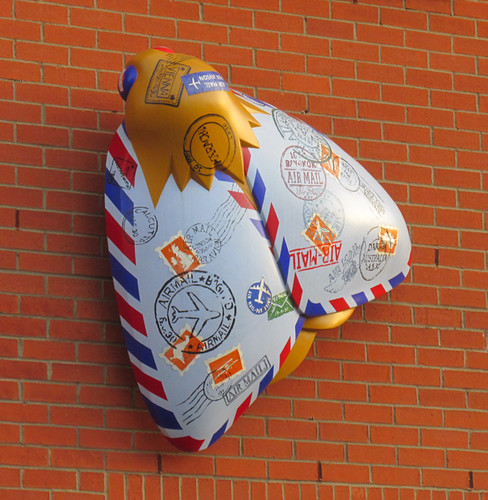
And here we have Air Mail by David Graham. It charts Amy's flight path and each of the stamps and post marks represents a time and place where she touched down. It also shows various ways that post has taken to the skies over the years - including by pigeon!
And here's Fly High, also by Pinky. It's supposed to represent Amy's achievements, both as a flyer and in her personal life, overcoming attitudes to women at the time.
The exhibition continues until March 2017.
This was the first one we found on our recent trip to Hull. (It's Mr Anorak's home town, of course.) It's called Horizon's Path and was created by artist Sam Tasker. The blue bit represents the freedom of the skies, the maroon bit signifies women's equality, and the white line represents Amy's flight path to Australia.
This is called Engineer, and it was painted by Hannah van Green. It's a mark of respect for Amy's mechanical skills.
This is World Moth by an artist called Pinky. It's inspired by the fact that Amy flew half way round the world, and represents some of the landscapes she must have passed along the way.
And here's Fly High, also by Pinky. It's supposed to represent Amy's achievements, both as a flyer and in her personal life, overcoming attitudes to women at the time.
The exhibition continues until March 2017.
September 09, 2016
Coventry
Hello and welcome again to Five on Friday, which is the brainchild of Amy at Love Made My Home. Don't forget to visit her blog to see other Friday Fives when you're done here.
Let me start with an apology. I shall be away from my computer for quite a lot of this week, so I might not get back to comment on your blogs as quickly as I'd like. But I'll do my best. I'm also short on time now, so I've dredged my Flickr stream to find something you might enjoy seeing.
Many years ago I visited Coventry, and my Dad and I went to see the cathedral. (Some years later, but still a long while ago, I ended up living in the city, but that's another story.)
Coventry was devastated during WWII by a German bombardment on the night of 14 November 1940, and its medieval cathedral was almost totally destroyed by incendiary devices. The Allies knew the bombers were coming, but nothing could be done to prevent the attack because the information had been gathered from a message sent in the Enigma code. The British had only just broken the code (Yes, my American friends, in spite of what you've seen at the movies, it was a team of Brits who broke Enigma.) but we couldn't afford to let the Germans know. It was felt that much more useful information might be gleaned from future messages, so Coventry was sacrificed.
Out of the wreckage, many years later, a phoenix was born, in the shape of the new Coventry Cathedral. The new building stands to the side of the remains of the old, forming a symbol of resurrection. (Note - I'm not a christian, but you can also spell that with a capital R, if you're that way inclined.) It incorporates some significant examples of architecture and art.
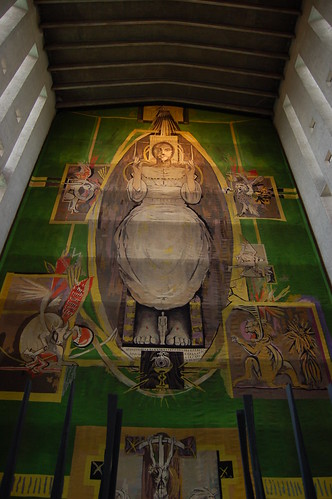
This is the extremely famous altar tapestry designed by Graham Sutherland. To give you an idea of its impact, the figure between Christ's feet is human sized. I remember my Dad's comment, that within the work there were some decent pictures trying to get out.I'm not sure I felt quite so unimpressed as he was, but I know what he meant.
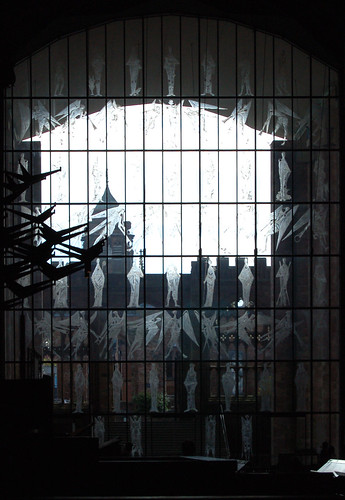
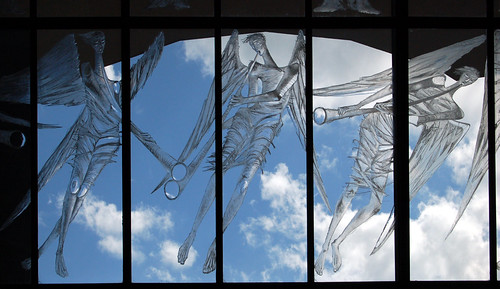
At the opposite end of the building is the magnificent window you can see in the top photo, designed by John Hutton. It forms the link between the old and new buildings. You can just make out the old ruins in that photo. You can't see the angels properly though, so I've put a detail in here as well.
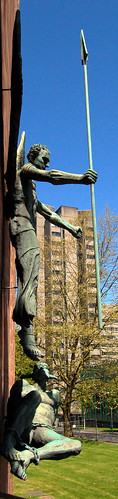
This is a rather unusual view of the Jacob Epstein sculpture "St Michael's Victory over the Devil". The 1958 bronze has come under fire in the past. Epstein sculpted the Devil with distinctly negroid features and the work has been accused of racism. However, Epstein was Jewish and was the target of a fair amount of racism during his lifetime. I'm not convinced that any slur was intended, but I admit I don't know enough about it to be sure. He was known for challenging accepted ideas and frequently depicted different forms of sexuality in his works. His private life wasn't exactly conventional either. It's possible that his negro Devil was just another way to challenge ingrained thoughts. Whatever, there's no arguing that he was a talented sculptor.
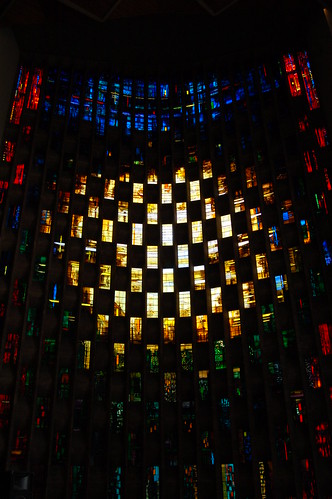
This is the magnificent baptistry window designed by John Piper. This photo doesn't do it justice. It's huge - on a similar scale to everything else in the building - and it really comes into its own when the sun shines. Coventry's an odd cathedral. When you walk into it there's very little light and colour except for the tapestry at the far end. It was designed (by Sir Basil Spence) with curious zig-zag walls so what you see in front of you is a series of concrete folds. However, when you get to the altar and then turn back you find that each of the folds hid a full height stained glass window in similar style to this one. It's stunning.
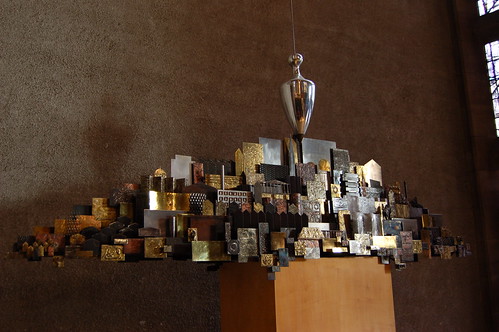
And finally, this is a sculpture called The Plumb Line and the City. It's by Clark Fitz-Gerald and symbolises god's way of testing the city to see if it's 'straight and true'. I was delighted after posting this photo to Flickr to receive a message from the artist's son asking for a copy of the picture. Praise indeed!
Let me start with an apology. I shall be away from my computer for quite a lot of this week, so I might not get back to comment on your blogs as quickly as I'd like. But I'll do my best. I'm also short on time now, so I've dredged my Flickr stream to find something you might enjoy seeing.
![]() |
| West window by John Hutton |
Coventry was devastated during WWII by a German bombardment on the night of 14 November 1940, and its medieval cathedral was almost totally destroyed by incendiary devices. The Allies knew the bombers were coming, but nothing could be done to prevent the attack because the information had been gathered from a message sent in the Enigma code. The British had only just broken the code (Yes, my American friends, in spite of what you've seen at the movies, it was a team of Brits who broke Enigma.) but we couldn't afford to let the Germans know. It was felt that much more useful information might be gleaned from future messages, so Coventry was sacrificed.
Out of the wreckage, many years later, a phoenix was born, in the shape of the new Coventry Cathedral. The new building stands to the side of the remains of the old, forming a symbol of resurrection. (Note - I'm not a christian, but you can also spell that with a capital R, if you're that way inclined.) It incorporates some significant examples of architecture and art.
![]() |
| Graham Sutherland tapestry |
This is the extremely famous altar tapestry designed by Graham Sutherland. To give you an idea of its impact, the figure between Christ's feet is human sized. I remember my Dad's comment, that within the work there were some decent pictures trying to get out.I'm not sure I felt quite so unimpressed as he was, but I know what he meant.
![]() |
| Angels detail |
At the opposite end of the building is the magnificent window you can see in the top photo, designed by John Hutton. It forms the link between the old and new buildings. You can just make out the old ruins in that photo. You can't see the angels properly though, so I've put a detail in here as well.
This is a rather unusual view of the Jacob Epstein sculpture "St Michael's Victory over the Devil". The 1958 bronze has come under fire in the past. Epstein sculpted the Devil with distinctly negroid features and the work has been accused of racism. However, Epstein was Jewish and was the target of a fair amount of racism during his lifetime. I'm not convinced that any slur was intended, but I admit I don't know enough about it to be sure. He was known for challenging accepted ideas and frequently depicted different forms of sexuality in his works. His private life wasn't exactly conventional either. It's possible that his negro Devil was just another way to challenge ingrained thoughts. Whatever, there's no arguing that he was a talented sculptor.
This is the magnificent baptistry window designed by John Piper. This photo doesn't do it justice. It's huge - on a similar scale to everything else in the building - and it really comes into its own when the sun shines. Coventry's an odd cathedral. When you walk into it there's very little light and colour except for the tapestry at the far end. It was designed (by Sir Basil Spence) with curious zig-zag walls so what you see in front of you is a series of concrete folds. However, when you get to the altar and then turn back you find that each of the folds hid a full height stained glass window in similar style to this one. It's stunning.
And finally, this is a sculpture called The Plumb Line and the City. It's by Clark Fitz-Gerald and symbolises god's way of testing the city to see if it's 'straight and true'. I was delighted after posting this photo to Flickr to receive a message from the artist's son asking for a copy of the picture. Praise indeed!
July 01, 2016
Five famous people
Here we are again on Friday taking part in Amy's Five on Friday. This week I've been trawling the photo collection for some sculptures of famous people. Be warned - I have enough of these to make it into several "Five" posts so you might get more in the future.
Meanwhile, let's start with someone you should recognise, even if I got the light very wrong and he's little more than a silhouette in this shot.
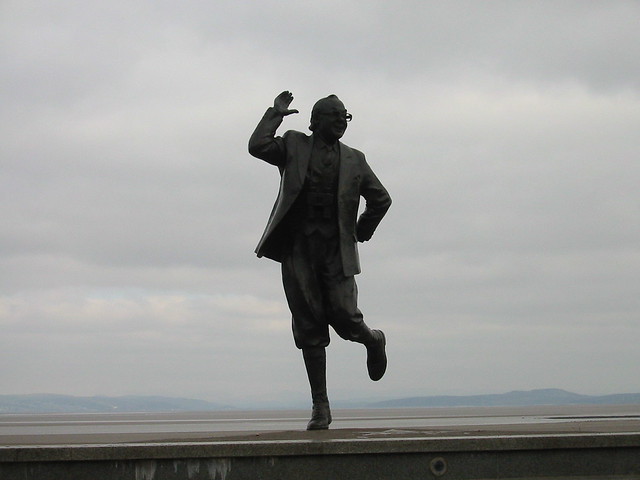
Sorry to my overseas readers if this guy isn't familiar to you but his name was Eric Morecambe, and he was half of a comedy duo who were very famous from the 60s onwards in the UK. In actual fact his name was Eric Bartholomew, but he took his stage name from his home town, Morecambe in Lancashire. And that's where this statue stands. That's Morecambe Bay in the background.
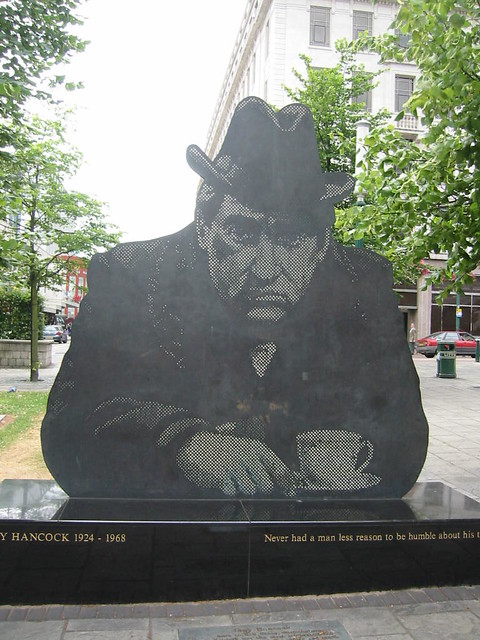
Another comedian - Tony Hancock. You don't really get the full effect here but the sculpture is sheet steel and the image is created by holes of various sizes drilled into it to let light pass through. (Much like an old print plate.) You don't get the scale in this shot either. But the plinth is big enough to sit on. It's in Old Square, Birmingham, close to where he was born. Hancock was known for his dry humour and comedy programmes on TV and radio. Remember The Blood Donor?
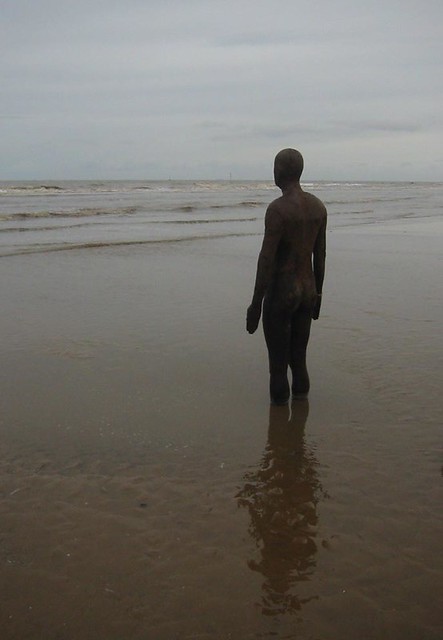
Even if you recognise this work you might not realise why I've included it among famous people. Much of Antony Gormley's work is based around nude figures similar to this. The photo is one of the Another Place installation on Crosby Beach near Liverpool. He's one of hundreds of cast iron figures standing looking out to sea. You might be more familiar with his Angel of the North, another - much bigger - cast iron figure, this time with airplane wings, that stands by the A1 near Gateshead. Whatever the size, these Gormley sculptures are actually self portraits. He bases all of these works on his own body. Hence its inclusion as somebody famous!
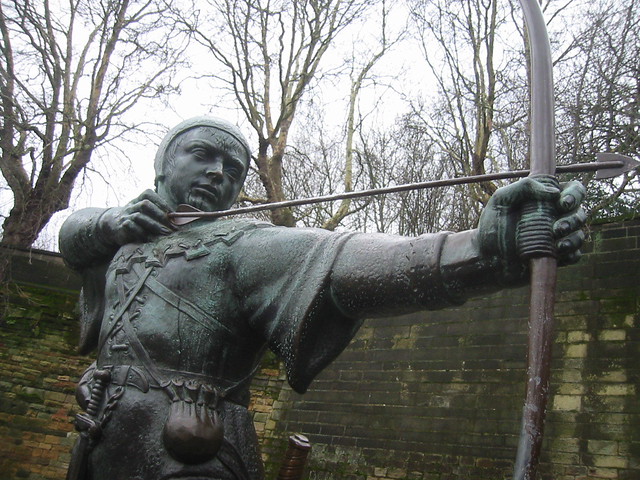
Famous, but not real. This stands near the gate of Nottingham Castle and tourists flock to see it. He's not one of my favourites. Raised on Errol Flynn movies, I find this child-like face bears no resemblance to the image of Robin Hood I have in my imagination. The locals seem to like him though, and his arrow frequently disappears during student Rag Week.
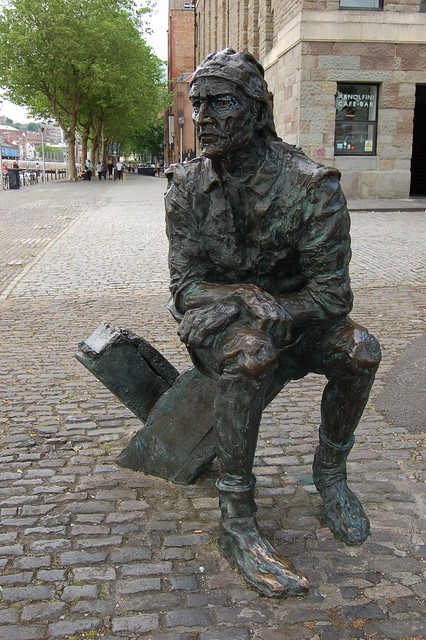
This chap sits on the quayside in Bristol, contemplating a long sea voyage. I don't know how accurate a portrait it is, but it represents John Cabot, explorer and navigator, who is credited with discovering parts of North America in the late 15th century during the reign of Henry VII. That's how they came up with the name Newfoundland. He's life size, and on a good day you can share a seat with him while you sip a takeaway coffee from the Arnolfini Gallery behind him.
Now please go and visit Any's blog at Love Made My Home to see what other people are sharing this week.
Meanwhile, let's start with someone you should recognise, even if I got the light very wrong and he's little more than a silhouette in this shot.
Sorry to my overseas readers if this guy isn't familiar to you but his name was Eric Morecambe, and he was half of a comedy duo who were very famous from the 60s onwards in the UK. In actual fact his name was Eric Bartholomew, but he took his stage name from his home town, Morecambe in Lancashire. And that's where this statue stands. That's Morecambe Bay in the background.
Another comedian - Tony Hancock. You don't really get the full effect here but the sculpture is sheet steel and the image is created by holes of various sizes drilled into it to let light pass through. (Much like an old print plate.) You don't get the scale in this shot either. But the plinth is big enough to sit on. It's in Old Square, Birmingham, close to where he was born. Hancock was known for his dry humour and comedy programmes on TV and radio. Remember The Blood Donor?
Even if you recognise this work you might not realise why I've included it among famous people. Much of Antony Gormley's work is based around nude figures similar to this. The photo is one of the Another Place installation on Crosby Beach near Liverpool. He's one of hundreds of cast iron figures standing looking out to sea. You might be more familiar with his Angel of the North, another - much bigger - cast iron figure, this time with airplane wings, that stands by the A1 near Gateshead. Whatever the size, these Gormley sculptures are actually self portraits. He bases all of these works on his own body. Hence its inclusion as somebody famous!
Famous, but not real. This stands near the gate of Nottingham Castle and tourists flock to see it. He's not one of my favourites. Raised on Errol Flynn movies, I find this child-like face bears no resemblance to the image of Robin Hood I have in my imagination. The locals seem to like him though, and his arrow frequently disappears during student Rag Week.
This chap sits on the quayside in Bristol, contemplating a long sea voyage. I don't know how accurate a portrait it is, but it represents John Cabot, explorer and navigator, who is credited with discovering parts of North America in the late 15th century during the reign of Henry VII. That's how they came up with the name Newfoundland. He's life size, and on a good day you can share a seat with him while you sip a takeaway coffee from the Arnolfini Gallery behind him.
Now please go and visit Any's blog at Love Made My Home to see what other people are sharing this week.
April 22, 2016
Five on Friday: hands
Welcome to Friday and my contribution to Five on Friday organised by Amy at Love Made My Home. This week I'm indulging a little hobby of mine. I love to take photos of hands - in particular the hands on sculptures. These five are all from statues of historic or significant figures.
Captain Vancouver
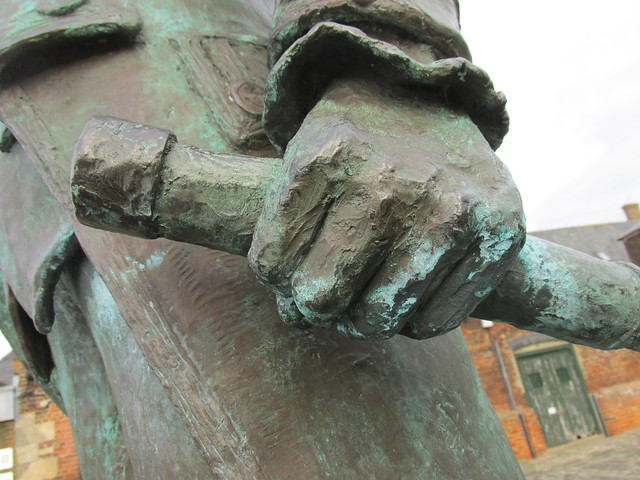
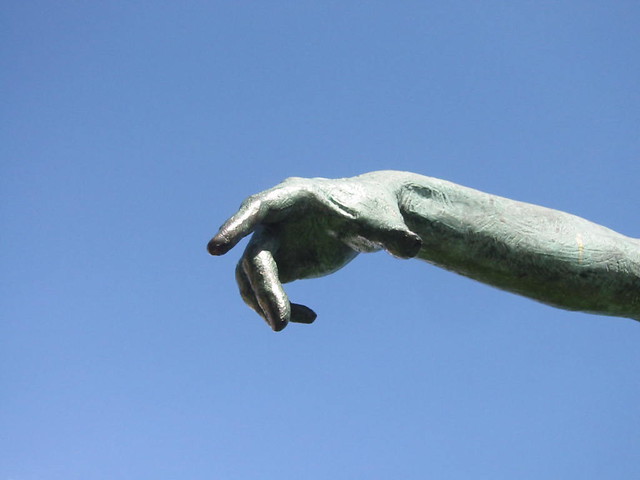
Captain George Vancouver was an English Naval officer, best known for his 1791–95 expedition to explore and chart North America's northwestern Pacific Coast. He was born in 1757 in Kings Lynn, Norfolk, and his statue stands proudly in front of the old Customs House in the town. He's holding a spyglass in his hand to watch out for new horizons.
Sir John Betjeman
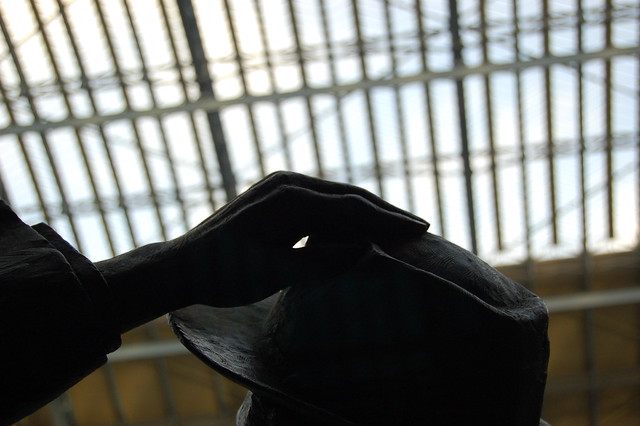
John Betjeman was a poet, and for many years was the UK's Poet Laureate. This statue of him stands on the upper deck at St Pancras Station in London. Betjeman was one of the driving forces behind a campaign to save the station when developers wanted to pull it down in the 1960s.
Patrick Lichfield
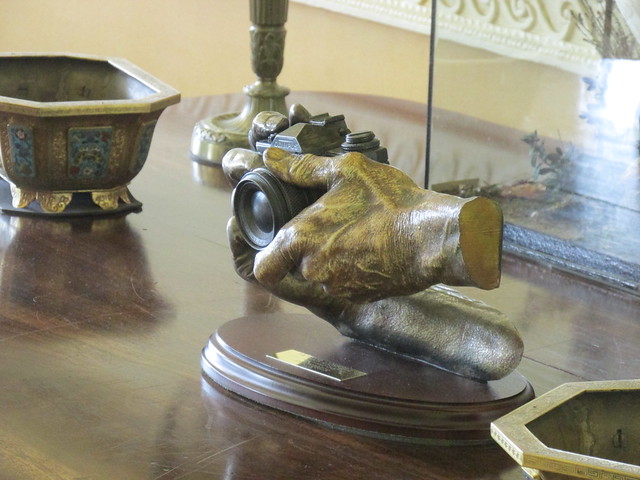
As you can see this sculpture is all about the hands. It stands on a desk in the former private apartment of Shugborough in Staffordshire, the ancestral home of Patrick, Earl of Lichfield. He was a well known society photographer and cousin of the Queen. His house was handed over to the National Trust in lieu of death duties after fate killed off both his father and his grandfather within a very short time. He was allowed to stay there in a rather luxurious apartment, which is now part of the house tour.
Constantine the Great
A seated figure of Emperor Constantine the Great reclines outside York Minster. It commemorates the fact that he was the first christian Roman emperor. He was proclaimed emperor at York just a few yards from where the sculpture now stands (on a spot that's now under the Minster building.)
The sculpture is by Philip Jackson, whose work I admire greatly. I realise that this portion doesn't give you much to go on, but trust me, it really sums up the incredible imperial arrogance that the rest of the work illustrates.
James Brindley
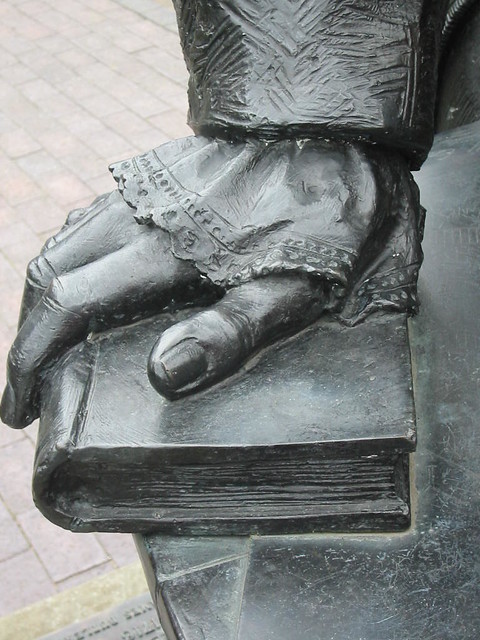
James Brindley was one of the foremost canal engineers of the eighteenth century. He was responsible for the first canal in Birmingham, which eventually led to the development of the complex network that criss-crosses the UK today. A statue of him stands at the terminal of the Coventry Canal, just off the modern-day ring road. It's a life-size bronze by Colin Melbourne and I love this little detail of the lacy cuff of his shirt.
So now there's just one last thing for you to do. Go visit Amy by clicking on the pic below, and see what everyone else has to offer this week.
Captain Vancouver
Captain George Vancouver was an English Naval officer, best known for his 1791–95 expedition to explore and chart North America's northwestern Pacific Coast. He was born in 1757 in Kings Lynn, Norfolk, and his statue stands proudly in front of the old Customs House in the town. He's holding a spyglass in his hand to watch out for new horizons.
Sir John Betjeman
John Betjeman was a poet, and for many years was the UK's Poet Laureate. This statue of him stands on the upper deck at St Pancras Station in London. Betjeman was one of the driving forces behind a campaign to save the station when developers wanted to pull it down in the 1960s.
Patrick Lichfield
As you can see this sculpture is all about the hands. It stands on a desk in the former private apartment of Shugborough in Staffordshire, the ancestral home of Patrick, Earl of Lichfield. He was a well known society photographer and cousin of the Queen. His house was handed over to the National Trust in lieu of death duties after fate killed off both his father and his grandfather within a very short time. He was allowed to stay there in a rather luxurious apartment, which is now part of the house tour.
Constantine the Great
A seated figure of Emperor Constantine the Great reclines outside York Minster. It commemorates the fact that he was the first christian Roman emperor. He was proclaimed emperor at York just a few yards from where the sculpture now stands (on a spot that's now under the Minster building.)
The sculpture is by Philip Jackson, whose work I admire greatly. I realise that this portion doesn't give you much to go on, but trust me, it really sums up the incredible imperial arrogance that the rest of the work illustrates.
James Brindley
James Brindley was one of the foremost canal engineers of the eighteenth century. He was responsible for the first canal in Birmingham, which eventually led to the development of the complex network that criss-crosses the UK today. A statue of him stands at the terminal of the Coventry Canal, just off the modern-day ring road. It's a life-size bronze by Colin Melbourne and I love this little detail of the lacy cuff of his shirt.
So now there's just one last thing for you to do. Go visit Amy by clicking on the pic below, and see what everyone else has to offer this week.
February 12, 2016
Five sculptures for a Friday
I've decided to join in with Five on Friday. It's a weekly meme that I read on other people's blogs but haven't joined before. It's celebrating its anniversary this week. That means it has a history! (See the bottom of the post for a link to find other blogs that join in.)
Here's five sculptures that commemorate some history of their own. Enjoy.
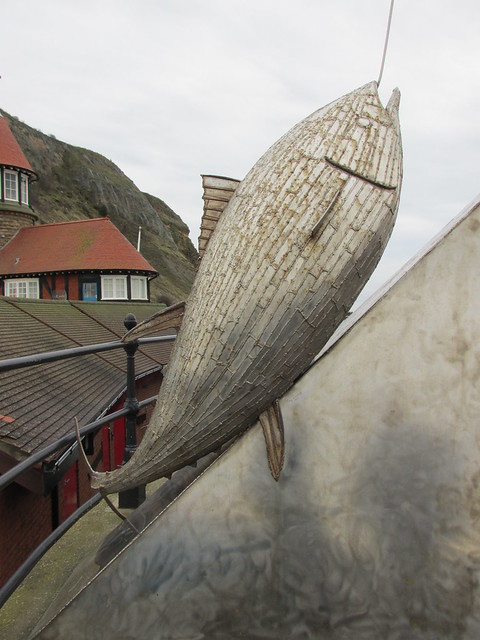
This links to a post on my other blog, about the tunny fishing club in Scarborough in the 1930s. The sculpture is by Ray Lonsdale and this is just a detail of it. Huge fish used to swim just offshore in the North Sea and anglers caught them with rod and line in spectacular battles against the very powerful animals. I suppose it depends on your view of "sport" but it was popular with the rich and famous.
This sculpture is near a path around East Midlands Airport and was made by children at the local primary school with the help of a professional artist. It's all to do with flight - as you can just see from the insect on the first slab. They're about the size of stepping stones.
I took this one years ago during a business trip to Jersey. It's in St Helier and remembers the jubilation when the Channel Islands were liberated from the Germans at the end of WWII.
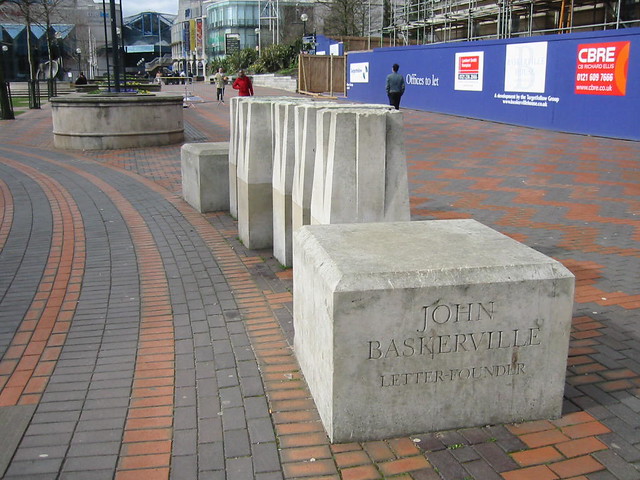
This one's a favourite. It's in Birmingham city centre and is called Industry and Genius. It commemorates type designer John Baskerville's factory, which stood nearby. The uprights represent individual letters from a press. They spell out Virgil, because that was the first book Baskerville produced.
Another Birmingham, and another favourite. They're Spitfires, of course, and the monument stands on a roundabout near where the fighter planes were once manufactured. It's huge. You can get the scale from the chevrons near the bottom of the photo. (It was also very bad weather when I was there!)
Here's five sculptures that commemorate some history of their own. Enjoy.
This links to a post on my other blog, about the tunny fishing club in Scarborough in the 1930s. The sculpture is by Ray Lonsdale and this is just a detail of it. Huge fish used to swim just offshore in the North Sea and anglers caught them with rod and line in spectacular battles against the very powerful animals. I suppose it depends on your view of "sport" but it was popular with the rich and famous.
This sculpture is near a path around East Midlands Airport and was made by children at the local primary school with the help of a professional artist. It's all to do with flight - as you can just see from the insect on the first slab. They're about the size of stepping stones.
I took this one years ago during a business trip to Jersey. It's in St Helier and remembers the jubilation when the Channel Islands were liberated from the Germans at the end of WWII.
This one's a favourite. It's in Birmingham city centre and is called Industry and Genius. It commemorates type designer John Baskerville's factory, which stood nearby. The uprights represent individual letters from a press. They spell out Virgil, because that was the first book Baskerville produced.
Another Birmingham, and another favourite. They're Spitfires, of course, and the monument stands on a roundabout near where the fighter planes were once manufactured. It's huge. You can get the scale from the chevrons near the bottom of the photo. (It was also very bad weather when I was there!)
Subscribe to:
Posts (Atom)