It's Friday again, so we're off to meet Amy at Love Made My Home for her Five on Friday feature. You might think after my Lincoln trip a couple of weeks ago that you've seen all there is to see about the Romans, but no. Here's some examples of Romans in Rome - well close to Rome, anyway.
The town of Ostia was ancient Rome's coastal resort and major port. Today it has been largely excavated, and extensively reconstructed, so you can wander around it and imagine what life must have been like all those years ago.
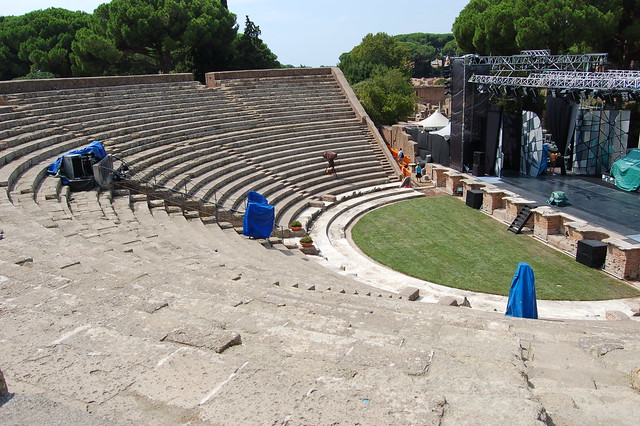
One of the most reconstructed areas is the old theatre. Plays are still staged here (or should that be staged here again?) and the staff were preparing it for a production when we visited - hence all the blue drapes and scaffolding. The audience sits on the tiers around the auditorium, of course. I imagine it's pretty uncomfortable, unless you take plenty of cushions!
This is the house of the doli. Doli (pronounced dough-lee) were huge storage jars, up to five or six feet high, and they were used by being buried in the ground, making them easier to reach in to and keeping the contents cooler. They could have stored anything - grain, flour, oil, whatever. Imagine a modern 'weigh and save' store.
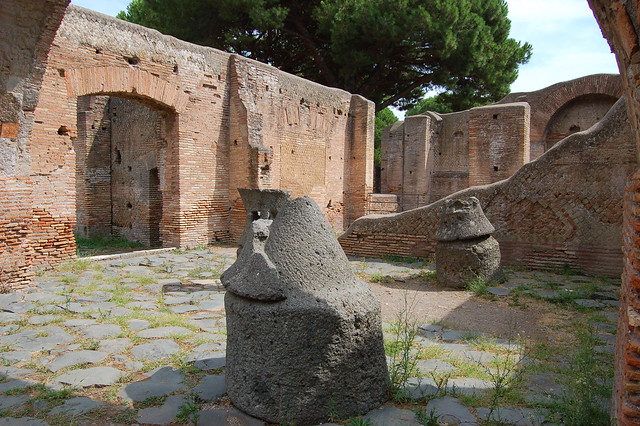
Here's the Mill of Sylvanus. It was a corn grinding mill, and those huge concrete-looking objects are the mill stones. You can just make out the cap on the conical base stone. The holes around the top would have had wooden bars inserted in them so that the top cap could be turned (probably by slaves because there isn't room for a donkey!) to grind flour as corn was poured into the top.
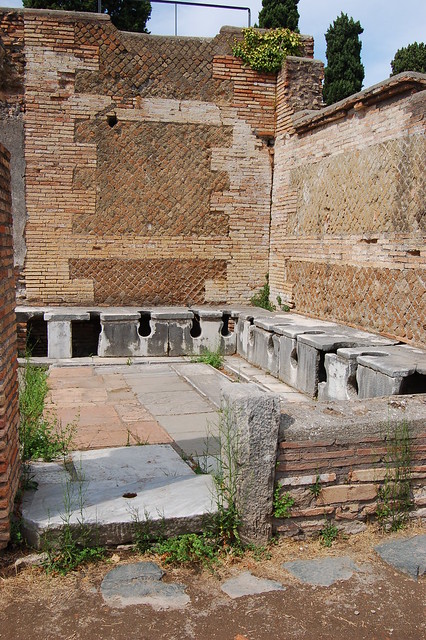
Guess what this is..... Yes. I'm sure you're right. It's a public loo. Roman latrines were communal affairs where users would sit alongside other participants to complete their ablutions. They also shared the means to clean themselves afterwards. Sponges on sticks were kept in a central pot where they could be rinsed with water before (and hopefully after) use.
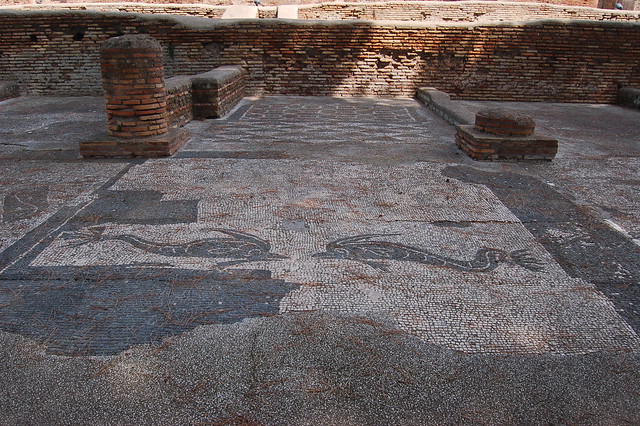
At the heart of town is an area called the Piazzale delle Corporazioni, or Square of the Traders. It is in the form of a quadrangle of small units with mosaic pavements outside them advertising their wares. This must have been a fishmonger - but other stores, if their mosaics are to be believed, dealt in such exotic stock as elephants!
So there is a brief introduction to Ostia Antica. Now pop over to see Amy and find other people's fives. Just click on the photo below.
Some chat about historical things. Some of it is inspired by topics on the associated History Anorak blog.
Showing posts with label Rome. Show all posts
April 29, 2016
April 22, 2016
Five on Friday: hands
Welcome to Friday and my contribution to Five on Friday organised by Amy at Love Made My Home. This week I'm indulging a little hobby of mine. I love to take photos of hands - in particular the hands on sculptures. These five are all from statues of historic or significant figures.
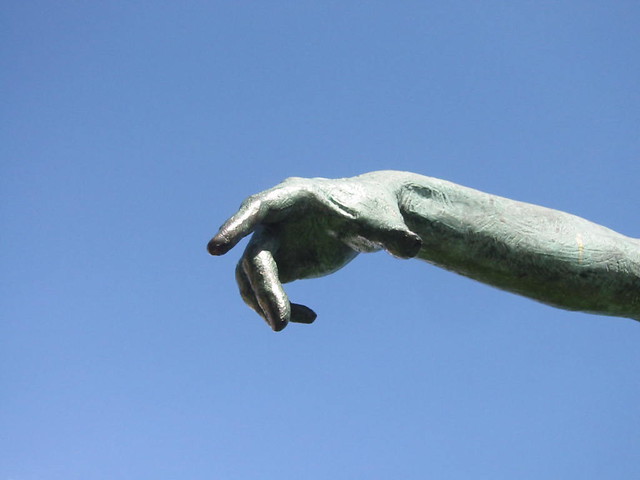
Captain Vancouver
Captain George Vancouver was an English Naval officer, best known for his 1791–95 expedition to explore and chart North America's northwestern Pacific Coast. He was born in 1757 in Kings Lynn, Norfolk, and his statue stands proudly in front of the old Customs House in the town. He's holding a spyglass in his hand to watch out for new horizons.
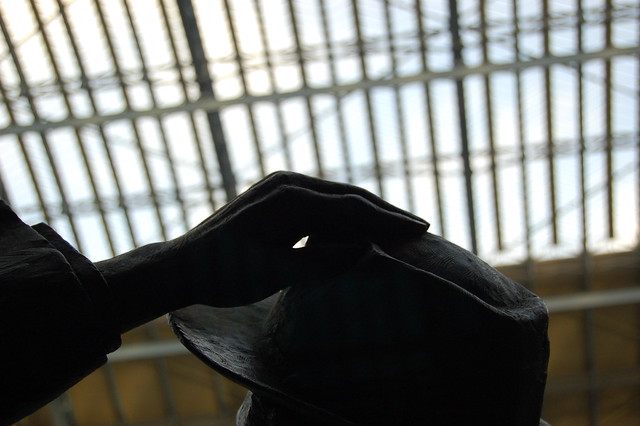
Sir John Betjeman
John Betjeman was a poet, and for many years was the UK's Poet Laureate. This statue of him stands on the upper deck at St Pancras Station in London. Betjeman was one of the driving forces behind a campaign to save the station when developers wanted to pull it down in the 1960s.
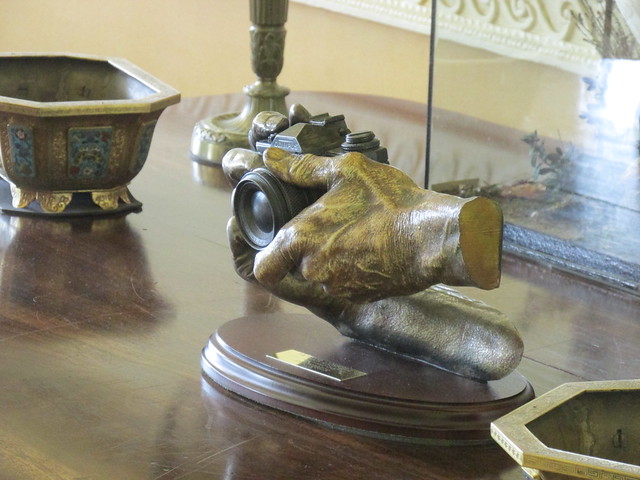
Patrick Lichfield
As you can see this sculpture is all about the hands. It stands on a desk in the former private apartment of Shugborough in Staffordshire, the ancestral home of Patrick, Earl of Lichfield. He was a well known society photographer and cousin of the Queen. His house was handed over to the National Trust in lieu of death duties after fate killed off both his father and his grandfather within a very short time. He was allowed to stay there in a rather luxurious apartment, which is now part of the house tour.
Constantine the Great
A seated figure of Emperor Constantine the Great reclines outside York Minster. It commemorates the fact that he was the first christian Roman emperor. He was proclaimed emperor at York just a few yards from where the sculpture now stands (on a spot that's now under the Minster building.)
The sculpture is by Philip Jackson, whose work I admire greatly. I realise that this portion doesn't give you much to go on, but trust me, it really sums up the incredible imperial arrogance that the rest of the work illustrates.
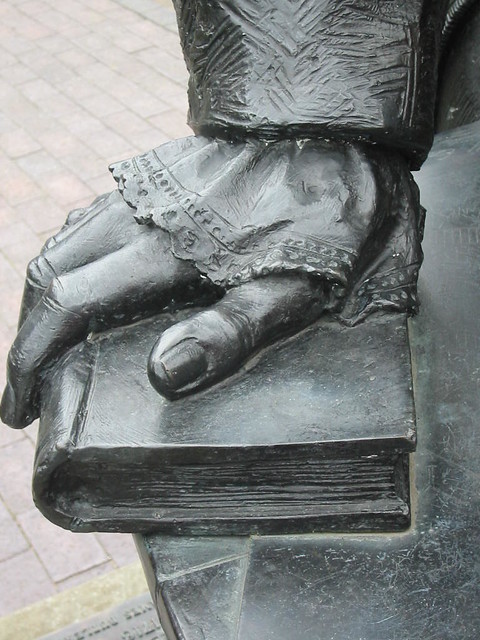
James Brindley
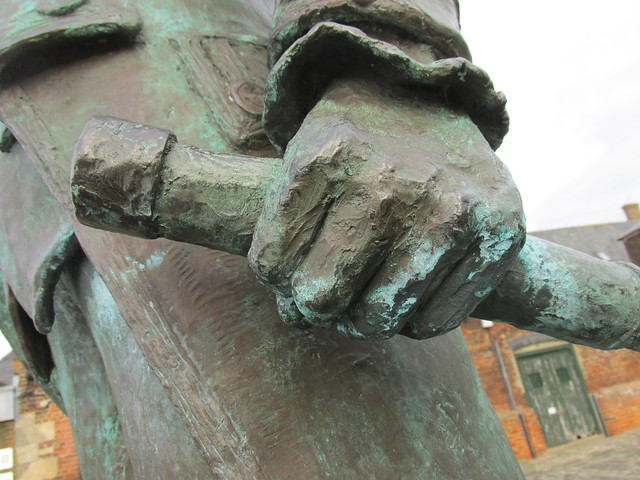
James Brindley was one of the foremost canal engineers of the eighteenth century. He was responsible for the first canal in Birmingham, which eventually led to the development of the complex network that criss-crosses the UK today. A statue of him stands at the terminal of the Coventry Canal, just off the modern-day ring road. It's a life-size bronze by Colin Melbourne and I love this little detail of the lacy cuff of his shirt.
So now there's just one last thing for you to do. Go visit Amy by clicking on the pic below, and see what everyone else has to offer this week.
Captain Vancouver
Captain George Vancouver was an English Naval officer, best known for his 1791–95 expedition to explore and chart North America's northwestern Pacific Coast. He was born in 1757 in Kings Lynn, Norfolk, and his statue stands proudly in front of the old Customs House in the town. He's holding a spyglass in his hand to watch out for new horizons.
Sir John Betjeman
John Betjeman was a poet, and for many years was the UK's Poet Laureate. This statue of him stands on the upper deck at St Pancras Station in London. Betjeman was one of the driving forces behind a campaign to save the station when developers wanted to pull it down in the 1960s.
Patrick Lichfield
As you can see this sculpture is all about the hands. It stands on a desk in the former private apartment of Shugborough in Staffordshire, the ancestral home of Patrick, Earl of Lichfield. He was a well known society photographer and cousin of the Queen. His house was handed over to the National Trust in lieu of death duties after fate killed off both his father and his grandfather within a very short time. He was allowed to stay there in a rather luxurious apartment, which is now part of the house tour.
Constantine the Great
A seated figure of Emperor Constantine the Great reclines outside York Minster. It commemorates the fact that he was the first christian Roman emperor. He was proclaimed emperor at York just a few yards from where the sculpture now stands (on a spot that's now under the Minster building.)
The sculpture is by Philip Jackson, whose work I admire greatly. I realise that this portion doesn't give you much to go on, but trust me, it really sums up the incredible imperial arrogance that the rest of the work illustrates.
James Brindley
James Brindley was one of the foremost canal engineers of the eighteenth century. He was responsible for the first canal in Birmingham, which eventually led to the development of the complex network that criss-crosses the UK today. A statue of him stands at the terminal of the Coventry Canal, just off the modern-day ring road. It's a life-size bronze by Colin Melbourne and I love this little detail of the lacy cuff of his shirt.
So now there's just one last thing for you to do. Go visit Amy by clicking on the pic below, and see what everyone else has to offer this week.
Subscribe to:
Posts (Atom)